


Page 262 - Design of Solar Thermal Power Plants
P. 262
4.3 DESIGN OF THE SOLAR TOWER POWER PLANT     245

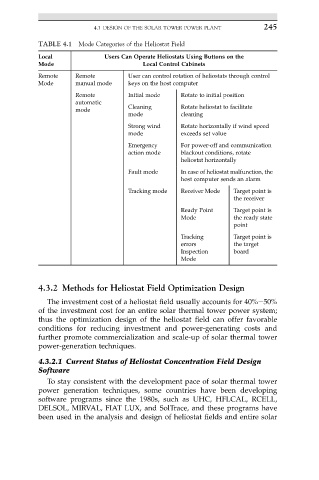
           TABLE 4.1 Mode Categories of the Heliostat Field
           Local             Users Can Operate Heliostats Using Buttons on the
           Mode                         Local Control Cabinets
           Remote    Remote         User can control rotation of heliostats through control
           Mode      manual mode    keys on the host computer
                     Remote         Initial mode  Rotate to initial position
                     automatic
                     mode           Cleaning      Rotate heliostat to facilitate
                                    mode          cleaning
                                    Strong wind   Rotate horizontally if wind speed
                                    mode          exceeds set value
                                    Emergency     For power-off and communication
                                    action mode   blackout conditions, rotate
                                                  heliostat horizontally
                                    Fault mode    In case of heliostat malfunction, the
                                                  host computer sends an alarm
                                    Tracking mode  Receiver Mode  Target point is
                                                                the receiver
                                                  Ready Point   Target point is
                                                  Mode          the ready state
                                                                point
                                                  Tracking      Target point is
                                                  errors        the target
                                                  Inspection    board
                                                  Mode


           4.3.2 Methods for Heliostat Field Optimization Design
              The investment cost of a heliostat field usually accounts for 40%e50%
           of the investment cost for an entire solar thermal tower power system;
           thus the optimization design of the heliostat field can offer favorable
           conditions for reducing investment and power-generating costs and
           further promote commercialization and scale-up of solar thermal tower
           power-generation techniques.
           4.3.2.1 Current Status of Heliostat Concentration Field Design
           Software
              To stay consistent with the development pace of solar thermal tower
           power generation techniques, some countries have been developing
           software programs since the 1980s, such as UHC, HFLCAL, RCELL,
           DELSOL, MIRVAL, FIAT LUX, and SolTrace, and these programs have
           been used in the analysis and design of heliostat fields and entire solar

