


Page 115 - Designing Autonomous Mobile Robots : Inside the Mindo f an Intellegent Machine
P. 115
Chapter 6

            For a send message, a client provides the post office with a pointer to the message da-
            ta, the size of the message, the remote processor (e.g., slave) to which the data is to
            be sent, and the destination address in that processor. The post office places all of this
            information into the next empty box and returns the message identification number
            to the client.

            For a request message, a client provides the remote processor and address from which
            it wants data, the number of bytes it wants. It may also pass a vector where it would
            like the post office to save the received data.

            When a message has been posted, the client will normally go about its business until
            it reaches the point of needing to know the status of its message. To determine this,
            the client calls the post office, and requests the status of the message by providing
            the message identification number. The post office will typically return one of the
            following status codes:
               1. Unsent (Post office has not yet gotten around to the message.)

               2. Pending (Message was sent but reply has not been received.)

               3. Completed
               4. Failed

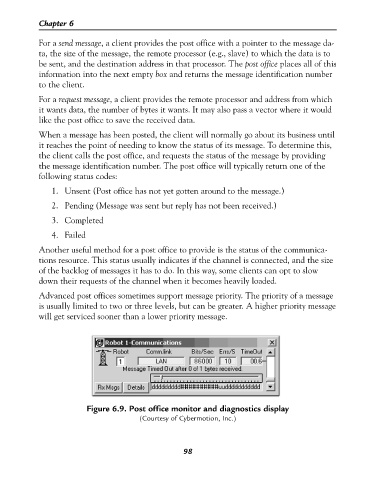
            Another useful method for a post office to provide is the status of the communica-
            tions resource. This status usually indicates if the channel is connected, and the size
            of the backlog of messages it has to do. In this way, some clients can opt to slow
            down their requests of the channel when it becomes heavily loaded.

            Advanced post offices sometimes support message priority. The priority of a message
            is usually limited to two or three levels, but can be greater. A higher priority message
            will get serviced sooner than a lower priority message.


                         Figure 6.9. Post office monitor and diagnostics display
                                        (Courtesy of Cybermotion, Inc.)


                                                    98

