


Page 20 - Designing Autonomous Mobile Robots : Inside the Mindo f an Intellegent Machine
P. 20
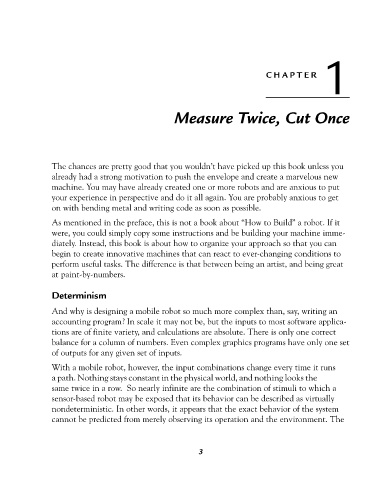
1
                                                                           CHAPTER


                                                 Measure Twice, Cut Once


               The chances are pretty good that you wouldn’t have picked up this book unless you
               already had a strong motivation to push the envelope and create a marvelous new
               machine. You may have already created one or more robots and are anxious to put
               your experience in perspective and do it all again. You are probably anxious to get
               on with bending metal and writing code as soon as possible.

               As mentioned in the preface, this is not a book about “How to Build” a robot. If it
               were, you could simply copy some instructions and be building your machine imme-
               diately. Instead, this book is about how to organize your approach so that you can
               begin to create innovative machines that can react to ever-changing conditions to
               perform useful tasks. The difference is that between being an artist, and being great
               at paint-by-numbers.


               Determinism
               And why is designing a mobile robot so much more complex than, say, writing an
               accounting program? In scale it may not be, but the inputs to most software applica-
               tions are of finite variety, and calculations are absolute. There is only one correct
               balance for a column of numbers. Even complex graphics programs have only one set
               of outputs for any given set of inputs.

               With a mobile robot, however, the input combinations change every time it runs
               a path. Nothing stays constant in the physical world, and nothing looks the
               same twice in a row.  So nearly infinite are the combination of stimuli to which a
               sensor-based robot may be exposed that its behavior can be described as virtually
               nondeterministic. In other words, it appears that the exact behavior of the system
               cannot be predicted from merely observing its operation and the environment. The


                                                        3

