


Page 23 - Designing Autonomous Mobile Robots : Inside the Mindo f an Intellegent Machine
P. 23
Chapter 1

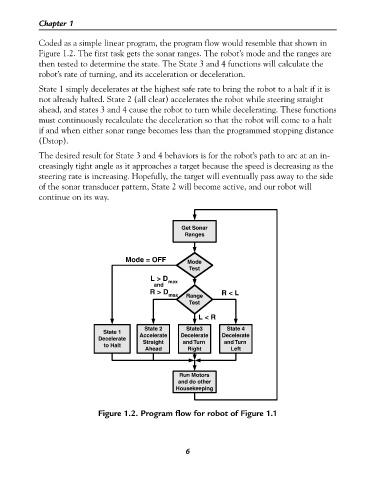
            Coded as a simple linear program, the program flow would resemble that shown in
            Figure 1.2. The first task gets the sonar ranges. The robot’s mode and the ranges are
            then tested to determine the state. The State 3 and 4 functions will calculate the
            robot’s rate of turning, and its acceleration or deceleration.

            State 1 simply decelerates at the highest safe rate to bring the robot to a halt if it is
            not already halted. State 2 (all clear) accelerates the robot while steering straight
            ahead, and states 3 and 4 cause the robot to turn while decelerating. These functions
            must continuously recalculate the deceleration so that the robot will come to a halt
            if and when either sonar range becomes less than the programmed stopping distance
            (Dstop).
            The desired result for State 3 and 4 behaviors is for the robot’s path to arc at an in-
            creasingly tight angle as it approaches a target because the speed is decreasing as the
            steering rate is increasing. Hopefully, the target will eventually pass away to the side
            of the sonar transducer pattern, State 2 will become active, and our robot will
            continue on its way.


                                                   Get Sonar
                                                    Ranges


                                    Mode = OFF       Mode
                                                      Test
                                           L > D max
                                            and
                                           R > D               R < L
                                                max  Range
                                                      Test
                                                        L < R

                                         State 2     State3     State 4
                              State 1
                            Decelerate  Accelerate  Decelerate  Decelerate
                                                    and Turn
                                         Straight
                                                               and Turn
                              to Halt
                                         Ahead       Right       Left
                                                   Run Motors
                                                  and do other
                                                  Housekeeping


                            Figure 1.2. Program flow for robot of Figure 1.1


                                                     6

