


Page 76 - Designing Autonomous Mobile Robots : Inside the Mindo f an Intellegent Machine
P. 76
Closed Loop Controls, Rabbits and Hounds

               controller. Since some of the terms of a PID do not work optimally in motor con-
               trols, we will consider the classical examples of PIDs in temperature control, and
               then work our way toward a configuration more capable of driving motors.

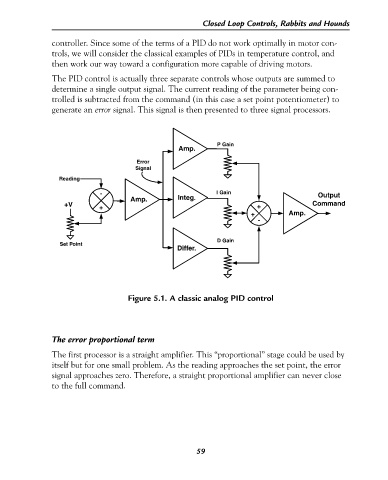
               The PID control is actually three separate controls whose outputs are summed to
               determine a single output signal. The current reading of the parameter being con-
               trolled is subtracted from the command (in this case a set point potentiometer) to
               generate an error signal. This signal is then presented to three signal processors.


                                                             P Gain
                                                   Amp.
                                       Error
                                       Signal
                 Reading
                             -                               I Gain                      Output
                                     Amp.         Integ.
                   +V                                                   +               Command
                             +
                                                                       +         Amp.
                                                                         -

                                                             D Gain
                  Set Point
                                                  Differ.


                                     Figure 5.1. A classic analog PID control


               The error proportional term

               The first processor is a straight amplifier. This “proportional” stage could be used by
               itself but for one small problem. As the reading approaches the set point, the error
               signal approaches zero. Therefore, a straight proportional amplifier can never close
               to the full command.


                                                        59

