


Page 84 - Designing Autonomous Mobile Robots : Inside the Mindo f an Intellegent Machine
P. 84
Closed Loop Controls, Rabbits and Hounds

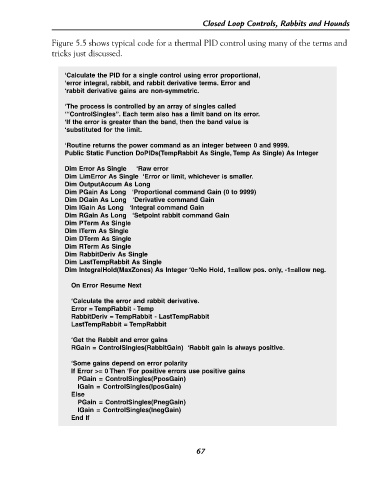
               Figure 5.5 shows typical code for a thermal PID control using many of the terms and
               tricks just discussed.


                   ‘Calculate the PID for a single control using error proportional,
                   ‘error integral, rabbit, and rabbit derivative terms. Error and
                   ‘rabbit derivative gains are non-symmetric.

                   ‘The process is controlled by an array of singles called
                   ‘“ControlSingles”. Each term also has a limit band on its error.
                   ‘If the error is greater than the band, then the band value is
                   ‘substituted for the limit.

                   ‘Routine returns the power command as an integer between 0 and 9999.
                   Public Static Function DoPIDs(TempRabbit As Single, Temp As Single) As Integer

                   Dim Error As Single     ‘Raw error
                   Dim LimError As Single  ‘Error or limit, whichever is smaller.
                   Dim OutputAccum As Long
                   Dim PGain As Long   ‘Proportional command Gain (0 to 9999)
                   Dim DGain As Long   ‘Derivative command Gain
                   Dim IGain As Long   ‘Integral command Gain
                   Dim RGain As Long   ‘Setpoint rabbit command Gain
                   Dim PTerm As Single
                   Dim ITerm As Single
                   Dim DTerm As Single
                   Dim RTerm As Single
                   Dim RabbitDeriv As Single
                   Dim LastTempRabbit As Single
                   Dim IntegralHold(MaxZones) As Integer ‘0=No Hold, 1=allow pos. only, -1=allow neg.

                     On Error Resume Next

                     ‘Calculate the error and rabbit derivative.
                     Error = TempRabbit - Temp
                     RabbitDeriv = TempRabbit - LastTempRabbit
                     LastTempRabbit = TempRabbit
                     ‘Get the Rabbit and error gains
                     RGain = ControlSingles(RabbitGain)  ‘Rabbit gain is always positive.

                     ‘Some gains depend on error polarity
                     If Error >= 0 Then ‘For positive errors use positive gains
                       PGain = ControlSingles(PposGain)
                       IGain = ControlSingles(IposGain)
                     Else
                       PGain = ControlSingles(PnegGain)
                       IGain = ControlSingles(InegGain)
                     End If


                                                        67

