


Page 231 - Designing Sociable Robots
P. 231
breazeal-79017  book  March 18, 2002  14:20


                       212                                                             Chapter 12


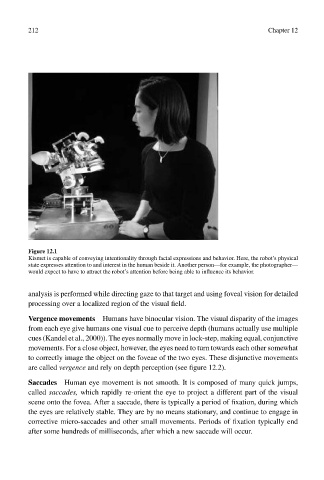
                       Figure 12.1
                       Kismet is capable of conveying intentionality through facial expressions and behavior. Here, the robot’s physical
                       state expresses attention to and interest in the human beside it. Another person—for example, the photographer—
                       would expect to have to attract the robot’s attention before being able to influence its behavior.

                       analysis is performed while directing gaze to that target and using foveal vision for detailed
                       processing over a localized region of the visual field.
                       Vergence movements Humans have binocular vision. The visual disparity of the images
                       from each eye give humans one visual cue to perceive depth (humans actually use multiple
                       cues (Kandel et al., 2000)). The eyes normally move in lock-step, making equal, conjunctive
                       movements. For a close object, however, the eyes need to turn towards each other somewhat
                       to correctly image the object on the foveae of the two eyes. These disjunctive movements
                       are called vergence and rely on depth perception (see figure 12.2).
                       Saccades Human eye movement is not smooth. It is composed of many quick jumps,
                       called saccades, which rapidly re-orient the eye to project a different part of the visual
                       scene onto the fovea. After a saccade, there is typically a period of fixation, during which
                       the eyes are relatively stable. They are by no means stationary, and continue to engage in
                       corrective micro-saccades and other small movements. Periods of fixation typically end
                       after some hundreds of milliseconds, after which a new saccade will occur.

