


Page 232 - Designing Sociable Robots
P. 232
breazeal-79017  book  March 18, 2002  14:20


                       Social Constraints on Animate Vision                                 213


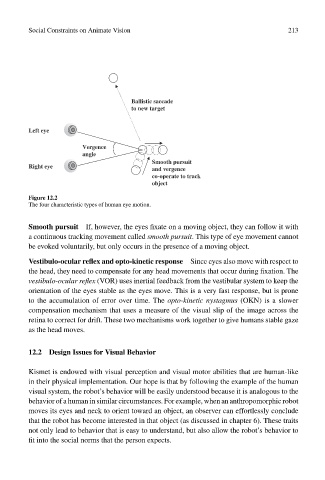
                                                  Ballistic saccade
                                                  to new target

                       Left eye

                                     Vergence
                                     angle
                                                       Smooth pursuit
                       Right eye
                                                       and vergence
                                                       co-operate to track
                                                       object
                       Figure 12.2
                       The four characteristic types of human eye motion.


                       Smooth pursuit If, however, the eyes fixate on a moving object, they can follow it with
                       a continuous tracking movement called smooth pursuit. This type of eye movement cannot
                       be evoked voluntarily, but only occurs in the presence of a moving object.

                       Vestibulo-ocular reflex and opto-kinetic response Since eyes also move with respect to
                       the head, they need to compensate for any head movements that occur during fixation. The
                       vestibulo-ocular reflex (VOR) uses inertial feedback from the vestibular system to keep the
                       orientation of the eyes stable as the eyes move. This is a very fast response, but is prone
                       to the accumulation of error over time. The opto-kinetic nystagmus (OKN) is a slower
                       compensation mechanism that uses a measure of the visual slip of the image across the
                       retina to correct for drift. These two mechanisms work together to give humans stable gaze
                       as the head moves.


                       12.2  Design Issues for Visual Behavior

                       Kismet is endowed with visual perception and visual motor abilities that are human-like
                       in their physical implementation. Our hope is that by following the example of the human
                       visual system, the robot’s behavior will be easily understood because it is analogous to the
                       behavior of a human in similar circumstances. For example, when an anthropomorphic robot
                       moves its eyes and neck to orient toward an object, an observer can effortlessly conclude
                       that the robot has become interested in that object (as discussed in chapter 6). These traits
                       not only lead to behavior that is easy to understand, but also allow the robot’s behavior to
                       fit into the social norms that the person expects.

