


Page 270 - Dynamic Loading and Design of Structures
P. 270
Page 241


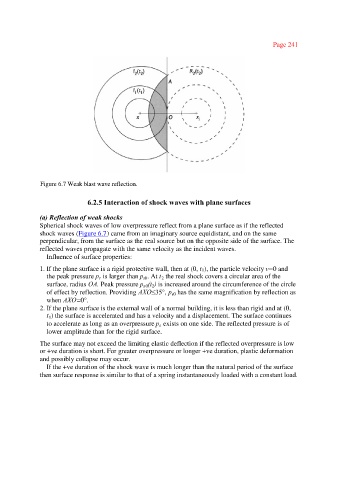
               Figure 6.7 Weak blast wave reflection.

                                6.2.5 Interaction of shock waves with plane surfaces


               (a) Reflection of weak shocks
               Spherical shock waves of low overpressure reflect from a plane surface as if the reflected
               shock waves (Figure 6.7) came from an imaginary source equidistant, and on the same
               perpendicular, from the surface as the real source but on the opposite side of the surface. The
               reflected waves propagate with the same velocity as the incident waves.
                 Influence of surface properties:

               1. If the plane surface is a rigid protective wall, then at (0, t1), the particle velocity v=0 and
                 the peak pressure p is larger than p . At t the real shock covers a circular area of the
                                                          2
                                                   s0
                                    r
                 surface, radius OA. Peak pressure p (t ) is increased around the circumference of the circle
                                                   s0 2
                 of effect by reflection. Providing AXO≤35°, p has the same magnification by reflection as
                                                             s0
                 when AXO=0°.
               2. If the plane surface is the external wall of a normal building, it is less than rigid and at (0,
                 t ) the surface is accelerated and has a velocity and a displacement. The surface continues
                  1
                 to accelerate as long as an overpressure p exists on one side. The reflected pressure is of
                                                         s
                 lower amplitude than for the rigid surface.
               The surface may not exceed the limiting elastic deflection if the reflected overpressure is low
               or +ve duration is short. For greater overpressure or longer +ve duration, plastic deformation
               and possibly collapse may occur.
                 If the +ve duration of the shock wave is much longer than the natural period of the surface
               then surface response is similar to that of a spring instantaneously loaded with a constant load.

