


Page 271 - Dynamic Loading and Design of Structures
P. 271
Page 242


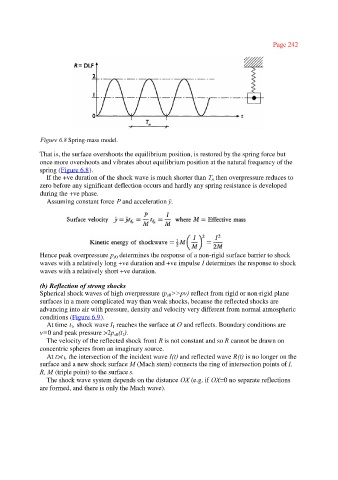
               Figure 6.8 Spring-mass model.

               That is, the surface overshoots the equilibrium position, is restored by the spring force but
               once more overshoots and vibrates about equilibrium position at the natural frequency of the
               spring (Figure 6.8).
                 If the +ve duration of the shock wave is much shorter than T then overpressure reduces to
                                                                           n
               zero before any significant deflection occurs and hardly any spring resistance is developed
               during the +ve phase.
                 Assuming constant force P and acceleration ÿ.


               Hence peak overpressure p determines the response of a non-rigid surface barrier to shock
                                         s0
               waves with a relatively long +ve duration and +ve impulse I determines the response to shock
               waves with a relatively short +ve duration.


               (b) Reflection of strong shocks
               Spherical shock waves of high overpressure (p >>pv) reflect from rigid or non-rigid plane
                                                            s0
               surfaces in a more complicated way than weak shocks, because the reflected shocks are
               advancing into air with pressure, density and velocity very different from normal atmospheric
               conditions (Figure 6.9).
                 At time t , shock wave I reaches the surface at O and reflects. Boundary conditions are
                          1
                                         1
               v=0 and peak pressure >2p (t ).
                                         s0 1
                 The velocity of the reflected shock front R is not constant and so R cannot be drawn on
               concentric spheres from an imaginary source.
                 At t>t1, the intersection of the incident wave I(t) and reflected wave R(t) is no longer on the
               surface and a new shock surface M (Mach stem) connects the ring of intersection points of I,
               R, M (triple point) to the surface s.
                 The shock wave system depends on the distance OX (e.g. if OX=0 no separate reflections
               are formed, and there is only the Mach wave).

