


Page 205 - Dynamics of Mechanical Systems
P. 205
0593_C06_fm Page 186 Monday, May 6, 2002 2:28 PM
186 Dynamics of Mechanical Systems
*
*
T . It is generally convenient to let F pass through the mass center G of the body. Then,
*
F and T are:
*
N
a )
F = ∑ − ( m ii (6.9.5)
*
= i 1
and:
N
T = r × − ( m a ) (6.9.6)
*
∑ i i i
= i 1
where r locates P relative to G.
i
i
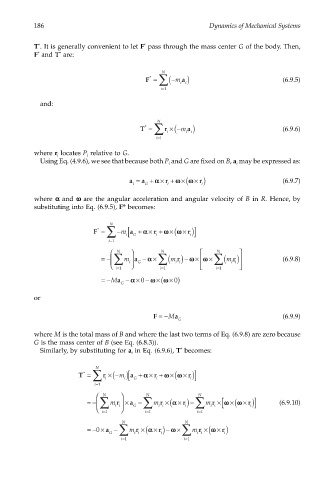
Using Eq. (4.9.6), we see that because both P and G are fixed on B, a may be expressed as:
i
i
a = a + αα × r + ωω ×(ωω × r ) (6.9.7)
i G i i
where αα αα and ωω ωω are the angular acceleration and angular velocity of B in R. Hence, by
substituting into Eq. (6.9.5), F* becomes:
N
F = ∑ −m [ i a + αα × r + ωω ×(ωω × r )]
*
G
i
i
= i 1
N N N
r ) − ωω
=− ∑ m i a − αα × ∑ (m i i × ωω × ∑ (m ii r ) (6.9.8)
G
i =1 = i 1 = i 1
× )
× − ωω
=−M a − αα 0 ×(ωω 0
G
or
F =−M a (6.9.9)
G
where M is the total mass of B and where the last two terms of Eq. (6.9.8) are zero because
G is the mass center of B (see Eq. (6.8.3)).
*
Similarly, by substituting for a in Eq. (6.9.6), T becomes:
i
N
T = r × − ( m + αα × r + ωω ×(ωω × r )]
*
∑ i i a )[ G i i
= i 1
N N N
[
=− ∑ m ii a − ∑ m i i × r ) − ∑ m ii r × ωω ×(ωω × r )] (6.9.10)
r ×(αα
r ×
i
i
G
i =1 = i 1 = i 1
N
G ∑
=− × a − N m i i × r ) − ωω × ∑ m i i × × )
r ×(αα
r ×(ωω r
0
i
i
= i 1 = i 1

