


Page 322 - Electrical Engineering Dictionary
P. 322
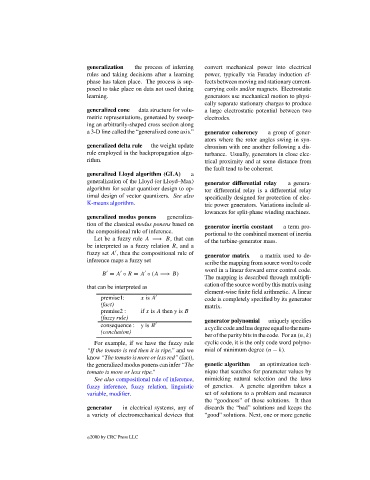
generalization  the process of inferring  convert mechanical power into electrical
                              rules and taking decisions after a learning  power, typically via Faraday induction ef-
                              phase has taken place. The process is sup-  fects between moving and stationary current-
                              posed to take place on data not used during  carrying coils and/or magnets. Electrostatic
                              learning.                              generators use mechanical motion to physi-
                                                                     cally separate stationary charges to produce
                              generalized cone  data structure for volu-  a large electrostatic potential between two
                              metric representations, generated by sweep-  electrodes.
                              ing an arbitrarily-shaped cross section along
                              a 3-D line called the “generalized cone axis.”  generator coherency  a group of gener-
                                                                     ators where the rotor angles swing in syn-
                              generalized delta rule  the weight update  chronism with one another following a dis-
                              rule employed in the backpropagation algo-  turbance. Usually, generators in close elec-
                              rithm.                                 trical proximity and at some distance from
                                                                     the fault tend to be coherent.
                              generalized Lloyd algorithm (GLA)  a
                              generalization of the Lloyd (or Lloyd–Max)  generator differential relay  a genera-
                              algorithm for scalar quantizer design to op-  tor differential relay is a differential relay
                              timal design of vector quantizers. See also  specifically designed for protection of elec-
                              K-means algorithm.                     tric power generators. Variations include al-
                                                                     lowances for split-phase winding machines.
                              generalized modus ponens  generaliza-
                              tion of the classical modus ponens based on
                                                                     generator inertia constant  a term pro-
                              the compositional rule of inference.
                                                                     portional to the combined moment of inertia
                                Let be a fuzzy rule A −→ B, that can
                                                                     of the turbine-generator mass.
                              be interpreted as a fuzzy relation R, and a
                                       0
                              fuzzy set A , then the compositional rule of
                                                                     generator matrix  a matrix used to de-
                              inference maps a fuzzy set
                                                                     scribe the mapping from source word to code
                                                                     word in a linear forward error control code.
                                    0
                                                 0
                                         0
                                   B = A ◦ R = A ◦ (A −→ B)
                                                                     The mapping is described through multipli-
                                                                     cation of the source word by this matrix using
                              that can be interpreted as
                                                                     element-wise finite field arithmetic. A linear
                                  premise1:     x is A 0             code is completely specified by its generator
                                  (fact)                             matrix.
                                  premise2 :    if x is A then y is B
                                  (fuzzy rule)
                                                                     generator polynomial  uniquely specifies
                                  consequence :  y is B  0           acycliccodeandhasdegreeequaltothenum-
                                  (conclusion)
                                                                     ber of the parity bits in the code. For an (n, k)
                                For example, if we have the fuzzy rule  cyclic code, it is the only code word polyno-
                              “If the tomato is red then it is ripe,” and we  mial of minimum degree (n − k).
                              know “The tomato is more or less red” (fact),
                              the generalized modus ponens can infer “The  genetic algorithm  an optimization tech-
                              tomato is more or less ripe.”          nique that searches for parameter values by
                                See also compositional rule of inference,  mimicking natural selection and the laws
                              fuzzy inference, fuzzy relation, linguistic  of genetics.  A genetic algorithm takes a
                              variable, modifier.                     set of solutions to a problem and measures
                                                                     the “goodness” of those solutions. It then
                              generator   in electrical systems, any of  discards the “bad” solutions and keeps the
                              a variety of electromechanical devices that  “good” solutions. Next, one or more genetic


                              c
2000 by CRC Press LLC

