


Page 112 - Electrical Installation in Hazardous Area
P. 112
88  Electrical installations in hazardous areas

                      a reasonable level. confidence and which have since given no indication
                      of  inadequacy. The  latest international Code, BS/EN  6079-103  which is
                      expected to  replace BS  5345, Part 2l  in the relatively near future has,  in
                      common with all of  its predecessors, failed to effectively approach the deter-
                      mination of  outdoor hazardous area extents by mathematical means indi-
                      cating that doubt still remains although it does contain a basic mathematical
                      relationship. Its subjective approach does, however, give some yardsticks
                      against which mathematically produced solutions can be measured and, as
                      this code has the confidence of  most of  the world’s developed countries, it
                      can serve to support the mathematical approaches included in this chapter.
                      This is helpful as, notwithstanding the difficulty in producing an approach
                      which will satisfy everyone, there remains the necessity to carry out the
                      business of  area classification.
                        For  the  above reasons the mathematical  approaches described  in  this
                      chapter are included in this book. The use of  these mathematical relation-
                      ships must, however, be carefully approached and only by those sufficiently
                      expert to identify their limitations. There is no evidence that the calcula-
                      tions described do anything but define hazardous areas at least as large
                      as is necessary when expertly used. This is because they are largely based
                      on ideal releases from nozzles rather than the accidental leaks which occur
                      due to failure of  such containment elements as glands and gaskets or, in
                      the case of  those included in the new IEC documenp, because of  the many
                      safety factors added.
                        The basis for  this  mathematical approach comes from sources such as
                      Perry4  and work  done by  Sutton and Katau based  on a combination of
                      fluid dynamics, kinetic theory of  gases and practical measurements. Most
                      of  these latter formulae were reported in British Standards Institution Draft
                      Document 79/270135 in 1979 and constituted the proposal for a calculative
                      approach which was not adopted as earlier described.


                      4.1 Releases of gas and vapour

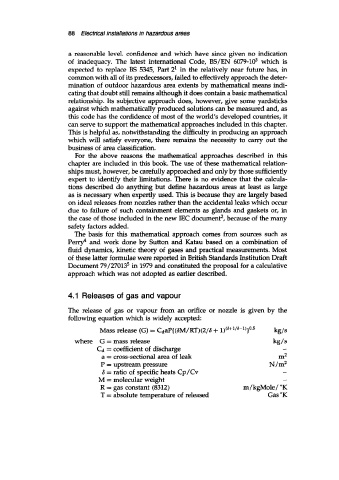
                      The release of  gas  or  vapour from an orifice or  nozzle  is given by  the
                      following equation which is widely accepted:
                               Mass release (G) = CdaP{ (SM/RT)(IZ/S + l)(b+i’s-i)}0.5  kg/s
                        where  G = mass release                                     kg/s
                               Cd  = coefficient of  discharge                         -
                                a = cross-sectional area of  leak                     m2
                                P = upstream pressure                              N/m2
                                6 = ratio of  specific heats Cp/Cv                     -
                               M = molecular weight                                    -
                                R = gas constant (8312)                    m/kgMole/ OK
                                T = absolute temperature of  released              Gas “K

