


Page 107 - Electrical Installation in Hazardous Area
P. 107
Area classification for gases, vapours and mists  83


                   and, in some cases, even to allow for the evacuation of the spaces between
                   the sample bottle and fixed valves before disconnection of  the sample bottle.
                   This is likely only in the case of  liquefied gases as, otherwise, the amount
                   of  flammable material stored in this interspace will be small if  the system is
                   properly designed. Again the objective is to effectively eliminate any Zone 1
                   so that only in abnormal operation will a hazardous area be present. These
                   abnormal situations will include valve seal failure, pipe-joint failure and
                   incorrect connection by personnel, the latter of  which would be expected
                   to be quickly corrected as the sampling personnel would be present. The
                   hazardous  area would, therefore, be most likely from pipe-joint or valve
                   failure, both  of  which  are  dealt with  in  sections 3.5.1 and 3.5.2 and  in
                   Table 3.2. The result of  this is as follows.
                     There are no Zones 0 and 1
                     Zone 2 consists of  an area in accordance with line 3 of  Table 3.2 around
                   the valve stem and an area in accordance with the appropriate column of
                   Table 3.2 around each joint, as shown in Fig. 3.16.


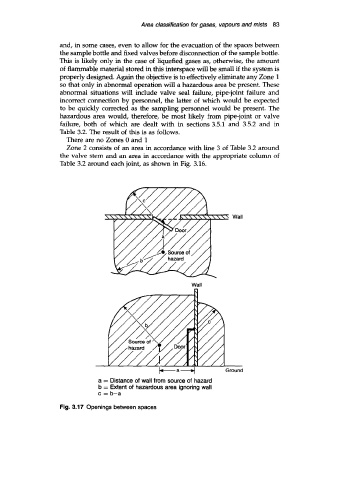
                                                                       Wall


                                                           Wall


                               a = Distance of wall from source of  hazard
                               b = Extent of hazardous area ignoring wall
                               c  = b-a
                   Fig. 3.17  Openings between spaces

