


Page 106 - Electrical Installation in Hazardous Area
P. 106
82  Electrical installations in hazardous areas


                      spillages into the tundish will be necessary. If  these techniques are used
                      the  release  of  flammable material  into the  atmosphere surrounding the
                      sampling point  in normal operation will be  minimal and  no  significant
                      Zone 1 will  exist. There will, however, remain the  possibility of  si@-
                      cant  release  in  abnormal operation due to  such things as failure of  the
                      sampling valve which will release too much liquid for the tundish to deal
                      with,  or blockage of  the tundish itself. In  both  of  these cases there will
                      be significant leakage of  flammable liquid and possible splashing around
                      the sampling point. This situation will produce a small Zone 2 around the
                      sampling point and a pool below it which will grow until it is contained
                      either physically or by the evaporation rate. It will then create a hazardous
                      area as defined in Table 3.7. The result of  this is given in Fig. 3.15 and is as
                      follows.
                        There are no Zones 0 and 1.
                        Zone 2 consists of  a sphere of  1 m around the sampling point and a pool
                      with surrounding hazardous area below it.
                        Where  the  flammable material  is  not  toxic  simpler  arrangements are
                      possible but not recommended as they will probably create larger hazardous
                      areas, the justification for which is doubtful in view of  the ease with which
                      the above arrangements can be  used. Details of  toxicity for  more  usual
                      materials is given in HSE Guidance Note EH 40.6


                      Sampling gases and vapours

                      Sampling gases, vapours and liquefied vapours under pressure can give rise
                      to a hazardous area of  significant proportions and cannot be permitted. It
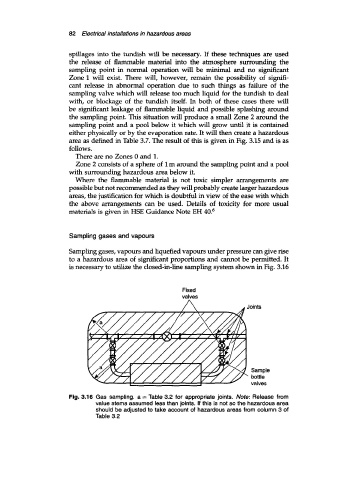
                      is necessary to utilize the closed-in-line sampling system shown in Fig. 3.16


                                                        Fixed
                                                        valves


                      Fig. 3.16  Gas sampling. a = Table 3.2  for  appropriate joints.  Note: Release from
                              value stems assumed less than joints.  If this is not so the hazardous area
                              should be adjusted to take account of  hazardous areas from column 3 of
                              Table 3.2

