


Page 219 - Electrical Installation in Hazardous Area
P. 219
General requirements for explosion protected apparatus  1 83


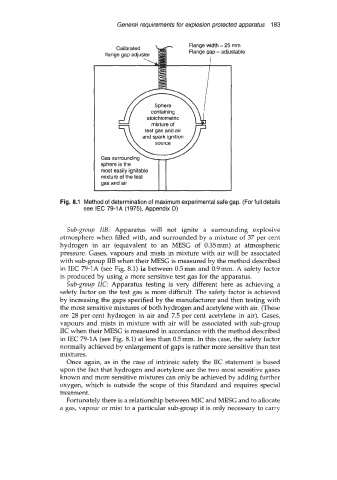
                                sphere is the
                                most easily ignitable
                                mixture of the test
                                gas and air


                   Fig. 8.1  Method of determination of maximum experimental safe gap. (For full details
                          see IEC 79-1A (19754, Appendix D)


                     Sub-group  IIB:  Apparatus  will  not  ignite  a  surrounding  explosive
                   atmosphere when filled with, and surrounded by a mixture of  37 per cent
                   hydrogen  in  air  (equivalent  to  an  MESG  of  0.35mm)  at  atmospheric
                   pressure. Gases, vapours and mists in mixture with air will be associated
                   with sub-group IIB when their MESG is measured by the method described
                   in IEC  79-1A (see Fig. 8.1) ia between 0.5mm and 0.9mm. A safety factor
                   is produced by using a more sensitive test gas for the apparatus.
                     Sub-group  IIC: Apparatus  testing  is very  different here  as achieving a
                   safety factor on the test gas is more difficult. The safety factor is achieved
                   by increasing the gaps specified by the manufacturer and then testing with
                   the most sensitive mixtures of both hydrogen and acetylene with air. (These
                   are 28 per cent  hydrogen in air and  7.5 per cent  acetylene in  air). Gases,
                   vapours and mists in mixture with air will be associated with sub-group
                   IIC when their MESG is measured in accordance with the method described
                   in IEC 79-1A (see Fig. 8.1) at less than 0.5 mm. In this case, the safety factor
                   normally achieved by enlargement of  gaps is rather more sensitive than test
                   mixtures.
                     Once again, as in the case of  intrinsic safety the IIC statement is based
                   upon the fact that hydrogen and acetylene are the two most sensitive gases
                   known and more sensitive mixtures can only be achieved by adding further
                   oxygen, which is outside the scope of  this Standard and  requires special
                   treatment.
                     Fortunately there is a relationship between MIC and MESG and to allocate
                   a gas, vapour or mist to a particular sub-group it is only necessary to carry

