


Page 223 - Electrical Installation in Hazardous Area
P. 223
General requirements for explosion protected apparatus  1 87


                   temperature class, and  then ensure that  the  surface does not  exceed the
                   following temperatures in service:

                       T1 - ignition temperature minus 50 "C
                       T2 - ignition temperature minus 50 "C
                       T3 - ignition temperature minus 50 "C
                       T4 - ignition temperature minus 25 "C
                       T5 - ignition temperature minus 25 "C
                       T6 - igrution temperature minus 25 "C
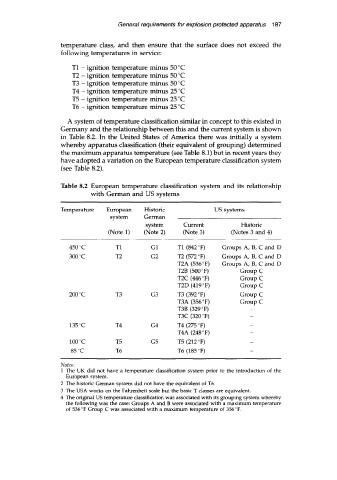
                     A system of temperature classification similar in concept to this existed in
                   Germany and the relationship between this and the current system is shown
                   in Table 8.2. In the United  States of  America there was initially a system
                   whereby apparatus classification (their equivalent of  grouping) determined
                   the maximum apparatus temperature (see Table 8.1) but in recent years they
                   have adopted a variation on the European temperature classification system
                   (see Table 8.2).

                   Table 8.2 European temperature classification system and  its relationship
                            with German and US systems

                   Temperature   European    Historic             US systems
                                  system     German
                                             system     Current           Historic
                                  (Note 1)   (Note 2)   (Note 3)       (Notes 3 and 4)

                      450 "C        T1         G1      T1 (842°F)   Groups A, B,  C and D
                      300 "C        T2         G2      T2 (572 "F)   Groups A, B,  C and D
                                                       T2A (536°F)   Groups A, B,  C and D
                                                                          Group C
                                                       T2B (500  OF)
                                                                          Group C
                                                       T2C (446 OF)
                                                       T2D (419°F)        Group C
                      200 "C        T3         G3      T3 (392 OF)        Group C
                                                       T3A (356°F)        Group C
                                                                             -
                                                       T3B (329  OF)
                                                       T3C (320°F)           -
                      135 "C        T4         G4      T4 (275 @F)
                                                       T4A (248 OF)
                      100 "C        T5         G5      T5 (212°F)
                      85 "C         T6                 T6 (185°F)
                   Notes:
                   1 The  UK did not have a temperature classification system prior to the introduction of  the
                     European system.
                   2  The historic German system did not have the equivalent of  T6.
                   3  The USA works on the Fahrenheit scale but the basic T classes are equivalent.
                   4  The original US temperature classification was associated with its grouping system whereby
                     the following was the case: Groups A and B were associated with a maximum temperature
                     of  536 "F Group C was associated with a maximum temperature of  356 "F.

