


Page 225 - Electrical Installation in Hazardous Area
P. 225
General requirements for explosion protected apparatus  1 89


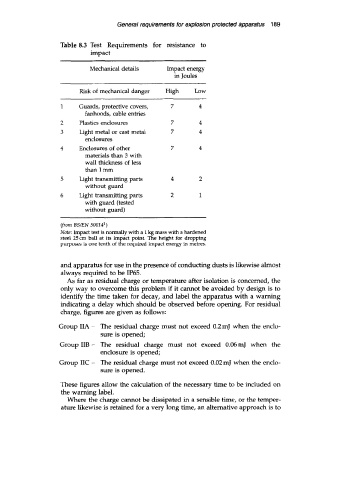
                   Table 8.3  Test  Requirements  for  resistance  to
                            impact

                            Mechanical details      Impact energy
                                                      in Joules
                         Risk of  mechanical danger   High   Low

                   1     Guards, protective covers,   7      4
                           fanhoods, cable entries
                   2     Plastics enclosures         7       4
                   3     Light metal or cast metal   7       4
                           enclosures
                   4     Enclosures of  other        7       4
                           materials than 3 with
                           wall thickness of  less
                           than 1 mm
                   5     Light transmitting parts    4
                           without guard
                   6     Light transmitting parts    2
                           with guard (tested
                           without guard)

                   (from BSEN 500241)
                   Note: Impact test is normally with a 1 kg mass with a hardened
                   steel 25cm ball at  its impact point. The height for dropping
                   purposes is one tenth of  the required impact energy in metres.

                   and apparatus for use in the presence of  conducting dusts is likewise almost
                   always required to be IP65.
                     As far as residual charge or temperature after isolation is concerned, the
                   only way to overcome this problem if  it cannot be avoided by design is to
                   identify the time taken for decay, and label the apparatus with a warning
                   indicating a delay which should be observed before opening. For residual
                   charge, figures are given as follows:

                   Group IIA  -  The residual charge must not exceed 0.2mJ when the enclo-
                                sure is opened;
                   Group IIB -  The  residual  charge  must  not  exceed  0.06mJ  when  the
                               enclosure is opened;
                   Group IIC -  The residual charge must not exceed 0.02mJ when the enclo-
                                sure is opened.

                   These figures allow the calculation of  the necessary time to be included on
                   the warning label.
                     Where the charge cannot be dissipated in a sensible time, or the temper-
                    ature likewise is retained for a very long time, an alternative approach is to

