


Page 132 - Encyclopedia of Chemical Compounds 3 Vols
P. 132
H
                                               H        H       N   H
                                                       C
                                                  C                      H
                                         H                C    C        N   H   H

                                           O    C             H    C        C   C     S     CH 3
                                                    C    C       O                       C

                                                   H        H               C   N
                                                                                      C     CH
                                                                        O                      3
                                                                                  H    C     O

                                                                                   OH


                    OTHER NAMES:
                    See Overview.

                        FORMULA:
                      C 16 H 19 N 3 O 5 S
                                         Amoxicillin
                       ELEMENTS:
                Carbon, hydrogen,
                 nitrogen, oxygen,
                          sulfur
                                         OVERVIEW
                  COMPOUND TYPE:  KE
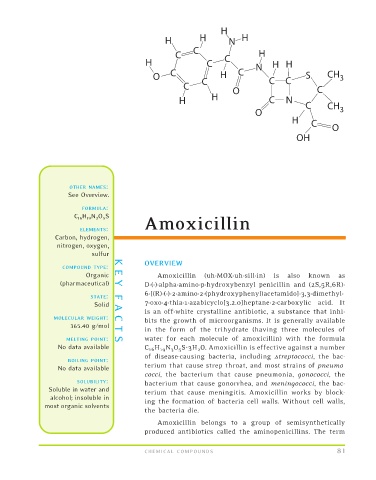
                         Organic             Amoxicillin  (uh-MOX-uh-sill-in)  is  also  known  as
                  (pharmaceutical)  Y    D-(-)-alpha-amino-p-hydroxybenzyl penicillin and (2S,5R,6R)-
                                         6-[(R)-(-)-2-amino-2-(phydroxyphenyl)acetamido]-3,3-dimethyl-
                          STATE:  F
                           Solid  A      7-oxo-4-thia-1-azabicyclo[3.2.0]heptane-2-carboxylic acid. It
                                         is an off-white crystalline antibiotic, a substance that inhi-
                MOLECULAR WEIGHT:  C
                                         bits the growth of microorganisms. It is generally available
                     365.40 g/mol
                                         in the form of the trihydrate (having three molecules of
                                 T
                   MELTING POINT:  S     water for each molecule of amoxicillin) with the formula
                 No data available       C 16 H 19 N 3 O 5 S 3H 2 O. Amoxicillin is effective against a number
                                         of disease-causing bacteria, including streptococci, the bac-
                    BOILING POINT:
                                         terium that cause strep throat, and most strains of pneumo
                 No data available
                                         cocci, the bacterium that cause pneumonia, gonococci, the
                      SOLUBILITY:        bacterium that cause gonorrhea, and meningococci, the bac-
              Soluble in water and
                                         terium that cause meningitis. Amoxicillin works by block-
               alcohol; insoluble in
                                         ing the formation of bacteria cell walls. Without cell walls,
             most organic solvents
                                         the bacteria die.
                                             Amoxicillin belongs to a group of semisynthetically
                                         produced antibiotics called the aminopenicillins. The term

                                         CHEMICAL COMPOUNDS                                   81

