


Page 150 - Encyclopedia of Chemical Compounds 3 Vols
P. 150
H

                                                         H          C         H
                                                               C         C


                                                               C         C
                                                         H          C         H

                                                                    H


                    OTHER NAMES:
                         Benzol;
                  cyclohexatriene
                        FORMULA:
                                         Benzene
                           C 6 H 6
                       ELEMENTS:
                 Carbon, hydrogen
                  COMPOUND TYPE:
                                         OVERVIEW
                  Aromatic hydro-  KE
                  carbon (organic)           Benzene (BEN-zeen) is a clear, colorless liquid with an
                                         aromatic (fragrant) odor. It occurs in coal and petroleum,
                          STATE:
                                 Y
                                         from which it is extracted for commercial use. Benzene is
                          Liquid  F
                                         very flammable, burning with a smoking flame. The com-
                MOLECULAR WEIGHT:  A     pound was discovered in 1825 by the English chemist and
                      78.11 g/mol  C
                                         physicist Michael Faraday (1791–1867), who gave the com-
                   MELTING POINT:  T     pound the name of bicarburet of hydrogen. It was given its


                    5.49 C (41.9 F)  S   modern name of benzene (benzin, at the time) by the German
                                         chemist Eilhardt Mitscherlich (1794–1863).
                    BOILING POINT:


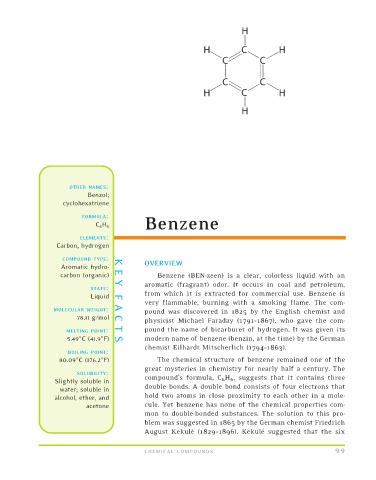
                 80.09 C (176.2 F)           The chemical structure of benzene remained one of the
                                         great mysteries in chemistry for nearly half a century. The
                      SOLUBILITY:
                                         compound’s formula, C 6 H 6 , suggests that it contains three
                Slightly soluble in
                                         double bonds. A double bond consists of four electrons that
                  water; soluble in
                alcohol, ether, and      hold two atoms in close proximity to each other in a mole-
                         acetone         cule. Yet benzene has none of the chemical properties com-
                                         mon to double-bonded substances. The solution to this pro-
                                         blem was suggested in 1865 by the German chemist Friedrich
                                         August Kekule ´ (1829–1896). Kekule ´ suggested that the six
                                         CHEMICAL COMPOUNDS                                   99

