


Page 212 - Encyclopedia of Chemical Compounds 3 Vols
P. 212
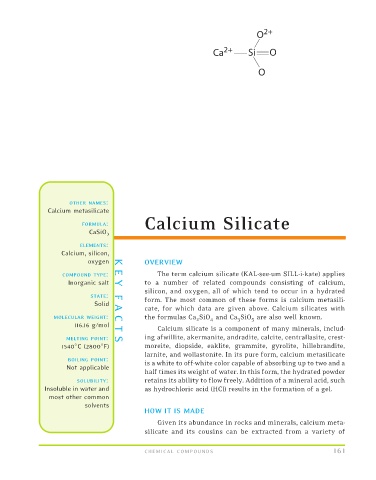
O 2+

                                                            Ca 2+     Si    O


                                                                         O


                    OTHER NAMES:
              Calcium metasilicate
                                         Calcium Silicate
                        FORMULA:
                          CaSiO 3
                       ELEMENTS:
                  Calcium, silicon,
                         oxygen  KE      OVERVIEW
                  COMPOUND TYPE:             The term calcium silicate (KAL-see-um SILL-i-kate) applies
                    Inorganic salt  Y    to a number of related compounds consisting of calcium,
                                         silicon, and oxygen, all of which tend to occur in a hydrated
                          STATE:  F
                                         form. The most common of these forms is calcium metasili-
                           Solid
                                         cate, for which data are given above. Calcium silicates with
                                 A
                MOLECULAR WEIGHT:  C     the formulas Ca 2 SiO 4 and Ca 3 SiO 5 are also well known.
                      116.16 g/mol
                                             Calcium silicate is a component of many minerals, includ-
                                 T
                   MELTING POINT:  S     ing afwillite, akermanite, andradite, calcite, centrallasite, crest-

                  1540 C (2800 F)        moreite, diopside, eaklite, grammite, gyrolite, hillebrandite,
                                         larnite, and wollastonite. In its pure form, calcium metasilicate
                    BOILING POINT:
                                         is a white to off-white color capable of absorbing up to two and a
                   Not applicable
                                         half times its weight of water. In this form, the hydrated powder
                      SOLUBILITY:        retains its ability to flow freely. Addition of a mineral acid, such
             Insoluble in water and      as hydrochloric acid (HCl) results in the formation of a gel.
               most other common
                         solvents
                                         HOW IT IS MADE
                                             Given its abundance in rocks and minerals, calcium meta-
                                         silicate and its cousins can be extracted from a variety of


                                         CHEMICAL COMPOUNDS                                  161

