


Page 217 - Encyclopedia of Chemical Compounds 3 Vols
P. 217
CALCIUM SULFATE


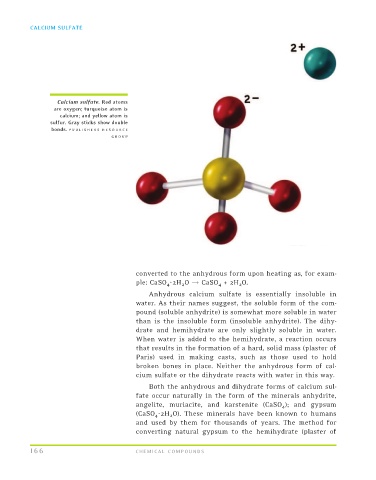
                 Calcium sulfate. Red atoms
                are oxygen; turquoise atom is
                  calcium; and yellow atom is
               sulfur. Gray sticks show double
               bonds. PUB L I S H E RS RE SO URCE
                                GRO U P


                                       converted to the anhydrous form upon heating as, for exam-
                                       ple: CaSO 4 2H 2 O ! CaSO 4 +2H 2 O.
                                          Anhydrous calcium sulfate is essentially insoluble in
                                       water. As their names suggest, the soluble form of the com-
                                       pound (soluble anhydrite) is somewhat more soluble in water
                                       than is the insoluble form (insoluble anhydrite). The dihy-
                                       drate and hemihydrate are only slightly soluble in water.
                                       When water is added to the hemihydrate, a reaction occurs
                                       that results in the formation of a hard, solid mass (plaster of
                                       Paris) used in making casts, such as those used to hold
                                       broken bones in place. Neither the anhydrous form of cal-
                                       cium sulfate or the dihydrate reacts with water in this way.
                                          Both the anhydrous and dihydrate forms of calcium sul-
                                       fate occur naturally in the form of the minerals anhydrite,
                                       angelite, muriacite, and karstenite (CaSO 4 ); and gypsum
                                       (CaSO 4 2H 2 O). These minerals have been known to humans
                                       and used by them for thousands of years. The method for
                                       converting natural gypsum to the hemihydrate (plaster of


         166                           CHEMICAL COMPOUNDS

