


Page 397 - Academic Press Encyclopedia of Physical Science and Technology 3rd InOrganic Chemistry
P. 397
P1: GQT/GRI  P2: GTV/FFV  P3: GTV/FFV  QC: GSS  Final pages
 Encyclopedia of Physical Science and Technology  EN014A-653  July 28, 2001  20:55


              Rare Earth Elements and Materials                                                            21

              the boiling point of liquid nitrogen, and significant com-  the high Tc substances. The inherent brittleness of ceram-
              mercial opportunities were forecast. The race to discover  ics prevents their fabrication into wires, and it now seems
              the chemical composition and crystal structure of the sin-  that the most promising way forward is the deposition of
              gle phase responsible for the superconductivity was one of  thin films of superconductor onto metal oxide or silver
              the most competitive and intense in the history of science.  surfaces to form flexible tapes.
              BylateMarch1987,becauseofreportsfromNRCCanada,
              Bellcore,  AT&T  Bell  Laboratories,  Argonne  National
              Laboratories, McMaster University, and others, the com-  V. CATALYSIS AND OTHER
              pound was identified as YBa 2 Cu 3 O 7 .              CHEMICAL APPLICATIONS
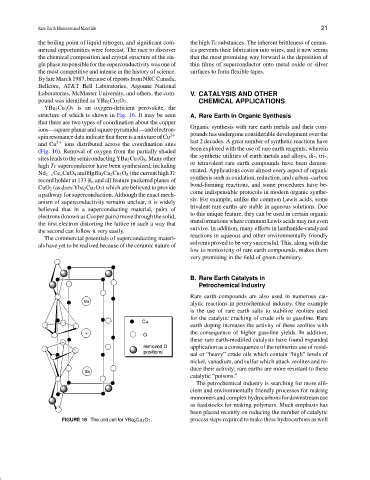
                YBa 2 Cu 3 O 7 is  an  oxygen-deficient  perovskite,  the
              structure of which is shown in Fig. 16. It may be seen  A. Rare Earth in Organic Synthesis
              that there are two types of coordination about the copper
                                                                Organic synthesis with rare earth metals and their com-
              ions—square planar and square pyramidal—and electron-
                                                                pounds has undergone considerable development over the
              spin resonance data indicate that there is a mixture of Cu 2+
                    3+                                          last 2 decades. A great number of synthetic reactions have
              and Cu  ions distributed across the coordination sites
                                                                been explored with the use of rare earth reagents, wherein
              (Fig. 16). Removal of oxygen from the partially shaded
                                                                the synthetic utilities of earth metals and alloys, di-, tri-,
              sites leads to the semiconducting YBa 2 Cu 3 O 6 . Many other
                                                                or tetravalent rare earth compounds have been demon-
              high Tc superconductor have been synthesized, including
                                                                strated. Applications cover almost every aspect of organic
              Nd 2−x Ce x CuO 4 and HgBa 2 Ca 2 Cu 3 O 8 (the current high Tc
                                                                synthesis such as oxidation, reduction, and carbon–carbon
              record holder at 133 K, and all feature puckered planes of
                                                                bond-forming reactions, and some procedures have be-
              CuO 2 (as does Yba 2 Cu 3 O 7 ) which are believed to provide
                                                                come indispensable protocols in modern organic synthe-
              a pathway for superconduction. Although the exact mech-
                                                                sis. For example, unlike the common Lewis acids, some
              anism of superconductivity remains unclear, it is widely
                                                                trivalent rare earths are stable in aqueous solutions. Due
              believed that in a superconducting material, pairs of
                                                                to this unique feature, they can be used in certain organic
              electrons (known as Cooper pairs) move through the solid,
                                                                transformations where common Lewis acids may not even
              the first electron distorting the lattice in such a way that
                                                                survive. In addition, many efforts in lanthanide-catalyzed
              the second can follow it very easily.
                                                                reactions in aqueous and other environmentally friendly
                The commercial potentials of superconducting materi-
                                                                solvents proved to be very successful. This, along with the
              als have yet to be realized because of the ceramic nature of
                                                                low to nontoxicity of rare earth compounds, makes them
                                                                very promising in the field of green chemistry.
                                                                B. Rare Earth Catalysts in
                                                                   Petrochemical Industry
                                                                Rare earth compounds are also used in numerous cat-
                                                                alytic reactions in petrochemical industry. One example
                                                                is the use of rare earth salts to stabilize zeolites used
                                                                for the catalytic cracking of crude oils to gasoline. Rare
                                                                earth doping increases the activity of these zeolites with
                                                                the consequence of higher gasoline yields. In addition,
                                                                these rare earth-modified catalysts have found expanded
                                                                application as a consequence of the refineries use of resid-
                                                                ual or “heavy” crude oils which contain “high” levels of
                                                                nickel, vanadium, and sulfur which attack zeolites and re-
                                                                duce their activity; rare earths are more resistant to these
                                                                catalytic “poisons.”
                                                                  The petrochemical industry is searching for more effi-
                                                                cient and environmentally friendly processes for making
                                                                monomers and complex hydrocarbons for downstream use
                                                                as feedstocks for making polymers. Much emphasis has
                                                                been placed recently on reducing the number of catalytic
                     FIGURE 16 The unit cell for YBa 2 Cu 3 O 7 .  process steps required to make these hydrocarbons as well

