


Page 145 -
P. 145
110     Enterprise Data Governance

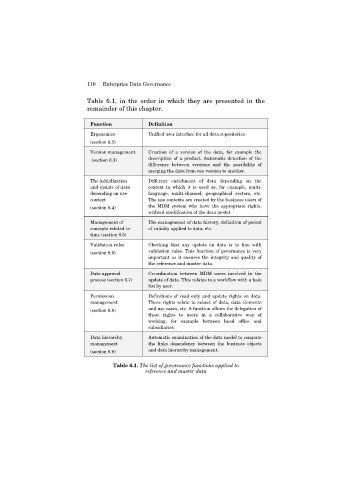
                                Table 6.1, in the order in which  they are presented in the
                                remainder of this chapter.

                                 Function            Definition

                                 Ergonomics          Unified user interface for all data repositories.
                                 (section 6.2)

                                 Version management   Creation of a version of the data, for example the
                                  (section 6.3)      description of a product.  Automatic detection of the
                                                     difference between versions and the possibility of
                                                     merging the data from one version to another.
                                 The initialization   Different enrichment of data depending on the
                                 and update of data   context in which it is used as, for example,  multi-
                                 depending on use    language,  multi-channel, geographical sectors, etc.
                                 context             The use contexts are created by the business users of
                                 (section 6.4)       the MDM system  who have the appropriate rights,
                                                     without modification of the data model.
                                 Management of       The management of data history, definition of period
                                 concepts related to   of validity applied to data, etc.
                                 time (section 6.5)
                                 Validation rules    Checking that  any  update on  data is in line with
                                 (section 6.6)       validation rules. This function of governance is very
                                                     important as it ensures the integrity and quality of
                                                     the reference and master data.
                                 Data approval       Co-ordination between MDM  users involved in the
                                 process (section 6.7)   update of data. This relates to a workflow with a task
                                                     list by user.
                                 Permission          Definitions of read only  and update rights on data.
                                 management          These rights relate to subset of data, data elements
                                 (section 6.8)       and use cases, etc. A function allows the delegation of
                                                     these rights to users in a collaborative way of
                                                     working, for example between head office and
                                                     subsidiaries.
                                 Data hierarchy      Automatic examination of the data model to compute
                                 management          the links dependency between  the business objects
                                 (section 6.9)       and data hierarchy management.

                                         Table 6.1. The list of governance functions applied to
                                                    reference and master data

