


Page 140 -
P. 140
104     Enterprise Data Governance

                                depends on the context in which the data  model is being
                                    4
                                used .
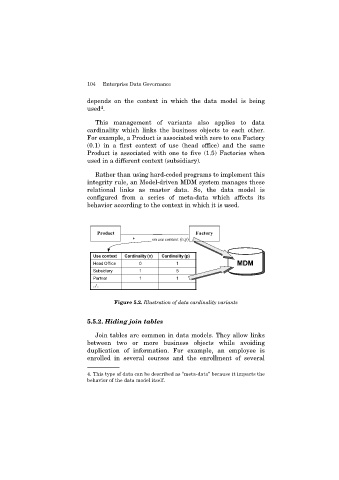
                                  This management of variants also applies to data
                                cardinality  which links the business objects to each other.
                                For example, a Product is associated with zero to one Factory
                                (0.1) in a first context of use (head office) and the same
                                Product is  associated with one to five (1.5) Factories when
                                used in a different context (subsidiary).

                                  Rather than using hard-coded programs to implement this
                                integrity rule, an Model-driven MDM system manages these
                                relational links as master data. So, the  data model is
                                configured  from a series of meta-data which affects  its
                                behavior according to the context in which it is used.


                                                                       Usine
                                    Produit
                                   Product                            Factory
                                                *     on use context (n,p)

                                  Use context  Cardinality (n)  Cardinality (p)
                                  Head Office     0            1                    MDM
                                  Subsidiary      1            5
                                  Partner         1            1
                                  ../..


                                         Figure 5.2. Illustration of data cardinality variants


                                5.5.2. Hiding join tables

                                  Join tables are common in data models. They allow links
                                between two or more business objects  while avoiding
                                duplication of information. For example, an employee is
                                enrolled in several courses and  the enrollment of several

                                4. This type of data can be described as “meta-data” because it impacts the
                                behavior of the data model itself.

