


Page 233 - Environmental Control in Petroleum Engineering
P. 233
Remediation of Contaminated Sites  219


 important to include all of the data in the analysis. Using the lowest
 measured concentrations and discarding the highest may be illegal.
   The difficulty in obtaining reliable data for the composition of
 contaminated sites was dramatically demonstrated through independent
 studies conducted by the U.S. Environmental Protection Agency and
 the American Petroleum Institute (Holliday and Deuel, 1990). In these
 studies, the same reserves pits, produced water pits, and production
 facilities were independently sampled and analyzed by the two agen-
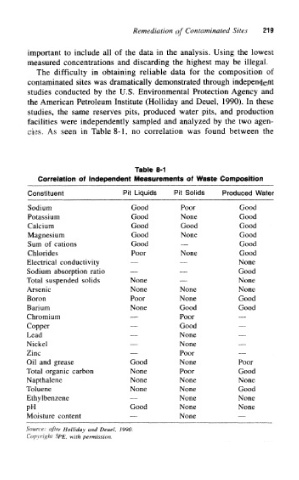
 cies. As seen in Table 8-1, no correlation was found between the


                             Table 8-1
   Correlation of Independent Measurements of Waste Composition
 Constituent              Pit Liquids  Pit Solids   Produced Water
 Sodium                     Good         Poor            Good
 Potassium                  Good         None            Good
 Calcium                    Good         Good            Good
 Magnesium                  Good         None            Good
 Sum of cations             Good         —               Good
 Chlorides                  Poor         None            Good
 Electrical conductivity    —            —               None
 Sodium absorption ratio    —                            Good
                                         —
 Total suspended solids     None         —               None
 Arsenic                    None         None            None
 Boron                      Poor         None           Good
 Barium                     None         Good           Good
 Chromium                   —            Poor           —
 Copper                     —            Good           —
 Lead                       __           None           ___
 Nickel                     ___          None
                                                        —
 Zinc                                    Poor           —
                            —
 Oil and grease             Good         None           Poor
 Total organic carbon       None         Poor           Good
 Napthalene                 None         None           None
 Toluene                    None         None           Good
 Ethylbenzene               —            None            None
 PH                         Good         None            None
 Moisture content           —            None           —
 Source: after Holliday and Deuel, 1990.
 Copyright SPE, with permission.

