


Page 126 - Excel Workbook for Dummies
P. 126
12_798452 ch07.qxp  3/13/06  7:51 PM  Page 109
                                                                          Chapter 7: Creating Date and Time Formulas  109

                                    10. Convert the fraction of the day into hours by editing the formula in cell C6 so
                                         that the program multiplies the difference between the two cells by 24.
                                         When editing the formula, be sure to enclose the subtraction operation in paren-
                                         theses so that Excel performs the subtraction first and then multiplies this differ-
                                         ence by 24 as in
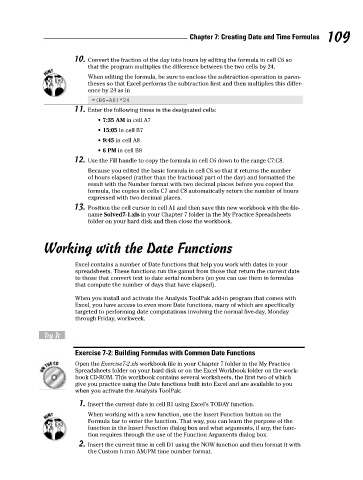
                                          =(B6-A6)*24
                                    11. Enter the following times in the designated cells:
                                            • 7:35 AM in cell A7
                                            • 15:05 in cell B7
                                            • 9:45 in cell A8

                                            • 6 PM in cell B8
                                    12. Use the Fill handle to copy the formula in cell C6 down to the range C7:C8.
                                         Because you edited the basic formula in cell C6 so that it returns the number
                                         of hours elapsed (rather than the fractional part of the day) and formatted the
                                         result with the Number format with two decimal places before you copied the
                                         formula, the copies in cells C7 and C8 automatically return the number of hours
                                         expressed with two decimal places.
                                    13. Position the cell cursor in cell A1 and then save this new workbook with the file-
                                         name Solved7-1.xls in your Chapter 7 folder in the My Practice Spreadsheets
                                         folder on your hard disk and then close the workbook.


                          Working with the Date Functions


                                    Excel contains a number of Date functions that help you work with dates in your
                                    spreadsheets. These functions run the gamut from those that return the current date
                                    to those that convert text to date serial numbers (so you can use them in formulas
                                    that compute the number of days that have elapsed).

                                    When you install and activate the Analysis ToolPak add-in program that comes with
                                    Excel, you have access to even more Date functions, many of which are specifically
                                    targeted to performing date computations involving the normal five-day, Monday
                                    through Friday, workweek.

                          Try It


                                    Exercise 7-2: Building Formulas with Common Date Functions
                                    Open the Exercise7-2.xls workbook file in your Chapter 7 folder in the My Practice
                                    Spreadsheets folder on your hard disk or on the Excel Workbook folder on the work-
                                    book CD-ROM. This workbook contains several worksheets, the first two of which
                                    give you practice using the Date functions built into Excel and are available to you
                                    when you activate the Analysis ToolPak:

                                     1. Insert the current date in cell B1 using Excel’s TODAY function.
                                         When working with a new function, use the Insert Function button on the
                                         Formula bar to enter the function. That way, you can learn the purpose of the
                                         function in the Insert Function dialog box and what arguments, if any, the func-
                                         tion requires through the use of the Function Arguments dialog box.

                                     2. Insert the current time in cell D1 using the NOW function and then format it with
                                         the Custom h:mm AM/PM time number format.

