


Page 577 - Fair, Geyer, and Okun's Water and wastewater engineering : water supply and wastewater removal
P. 577
JWCL344_ch14_500-554.qxd  8/7/10  8:56 PM  Page 533


                                                                                         14.14 Force Main Sewers  533
                    14.14.4  Design Criteria

                                         Force main design is typically integrated with lift station design. The major factors to con-
                                         sider when analyzing force main materials and hydraulics include the design formula for
                                         sizing the pipe, friction losses, pressure surges, and maintenance. The Hazen-Williams for-
                                         mula is recommended for the design of force mains. This formula includes a roughness
                                         coefficient C, which accounts for pipeline hydraulic friction characteristics. The roughness
                                         coefficient varies with pipe material, size, and age.

                                         14.14.4.1 Force Main Pipe Materials Selection criteria for force main pipe materials include

                                             1. Wastewater quantity, quality, and pressure
                                             2. Pipe properties, such as strength, ease of handling, and corrosion resistance
                                             3. Availability of appropriate sizes, wall thickness, and fittings
                                             4. Hydraulic friction characteristics
                                             5. Cost.
                                             Ductile iron pipe offers strength, stiffness, ductility, and a range of sizes and thicknesses
                                         and is the typical choice for high-pressure and exposed piping. Plastic pipe is most widely
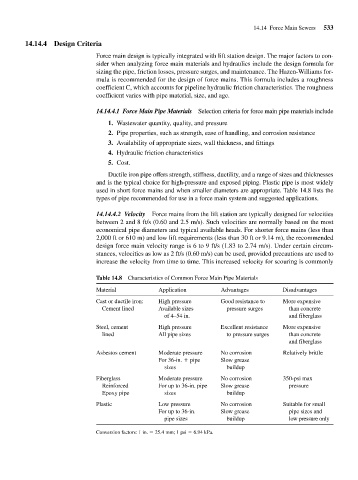
                                         used in short force mains and when smaller diameters are appropriate. Table 14.8 lists the
                                         types of pipe recommended for use in a force main system and suggested applications.

                                         14.14.4.2 Velocity  Force mains from the lift station are typically designed for velocities
                                         between 2 and 8 ft/s (0.60 and 2.5 m/s). Such velocities are normally based on the most
                                         economical pipe diameters and typical available heads. For shorter force mains (less than
                                         2,000 ft or 610 m) and low lift requirements (less than 30 ft or 9.14 m), the recommended
                                         design force main velocity range is 6 to 9 ft/s (1.83 to 2.74 m/s). Under certain circum-
                                         stances, velocities as low as 2 ft/s (0.60 m/s) can be used, provided precautions are used to
                                         increase the velocity from time to time. This increased velocity for scouring is commonly

                                         Table 14.8  Characteristics of Common Force Main Pipe Materials
                                         Material           Application        Advantages         Disadvantages

                                         Cast or ductile iron:  High pressure  Good resistance to   More expensive
                                           Cement lined     Available sizes      pressure surges    than concrete
                                                              of 4–54 in.                           and fiberglass
                                         Steel, cement      High pressure      Excellent resistance   More expensive
                                           lined            All pipe sizes       to pressure surges  than concrete
                                                                                                    and fiberglass
                                         Asbestos cement    Moderate pressure  No corrosion       Relatively brittle
                                                            For 36-in. 	 pipe   Slow grease
                                                              sizes              buildup
                                         Fiberglass         Moderate pressure  No corrosion       350-psi max
                                           Reinforced       For up to 36-in. pipe   Slow grease     pressure
                                           Epoxy pipe         sizes              buildup
                                         Plastic            Low pressure       No corrosion       Suitable for small
                                                            For up to 36-in.   Slow grease          pipe sizes and
                                                              pipe sizes         buildup            low pressure only
                                         Conversion factors: 1 in.   25.4 mm; 1 psi   6.94 kPa.

