


Page 578 - Fair, Geyer, and Okun's Water and wastewater engineering : water supply and wastewater removal
P. 578
JWCL344_ch14_500-554.qxd  8/7/10  8:56 PM  Page 534


                    534  Chapter 14  Design of Sewer Systems
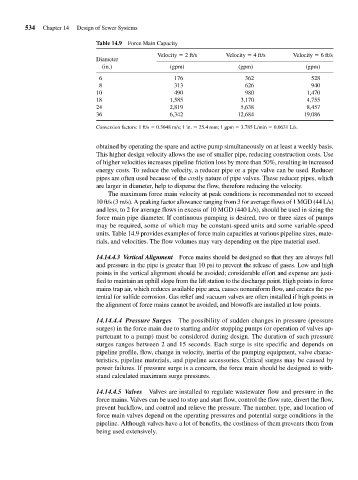
                                         Table 14.9  Force Main Capacity

                                                            Velocity   2 ft/s    Velocity   4 ft/s   Velocity   6 ft/s
                                         Diameter
                                           (in.)                (gpm)                (gpm)               (gpm)
                                          6                      176                   362                 528
                                          8                      313                   626                 940
                                         10                      490                   980               1,470
                                         18                     1,585                3,170               4,755
                                         24                     2,819                5,638               8,457
                                         36                     6,342               12,684               19,086
                                         Conversion factors: 1 ft/s   0.3048 m/s; 1 in.   25.4 mm; 1 gpm   3.785 L/min   0.0631 L/s.


                                         obtained by operating the spare and active pump simultaneously on at least a weekly basis.
                                         This higher design velocity allows the use of smaller pipe, reducing construction costs. Use
                                         of higher velocities increases pipeline friction loss by more than 50%, resulting in increased
                                         energy costs. To reduce the velocity, a reducer pipe or a pipe valve can be used. Reducer
                                         pipes are often used because of the costly nature of pipe valves. These reducer pipes, which
                                         are larger in diameter, help to disperse the flow, therefore reducing the velocity.
                                             The maximum force main velocity at peak conditions is recommended not to exceed
                                         10 ft/s (3 m/s). A peaking factor allowance ranging from 3 for average flows of 1 MGD (44 L/s)
                                         and less, to 2 for average flows in excess of 10 MGD (440 L/s), should be used in sizing the
                                         force main pipe diameter. If continuous pumping is desired, two or three sizes of pumps
                                         may be required, some of which may be constant-speed units and some variable-speed
                                         units. Table 14.9 provides examples of force main capacities at various pipeline sizes, mate-
                                         rials, and velocities. The flow volumes may vary depending on the pipe material used.

                                         14.14.4.3 Vertical Alignment Force mains should be designed so that they are always full
                                         and pressure in the pipe is greater than 10 psi to prevent the release of gases. Low and high
                                         points in the vertical alignment should be avoided; considerable effort and expense are justi-
                                         fied to maintain an uphill slope from the lift station to the discharge point. High points in force
                                         mains trap air, which reduces available pipe area, causes nonuniform flow, and creates the po-
                                         tential for sulfide corrosion. Gas relief and vacuum valves are often installed if high points in
                                         the alignment of force mains cannot be avoided, and blowoffs are installed at low points.

                                         14.14.4.4 Pressure Surges  The possibility of sudden changes in pressure (pressure
                                         surges) in the force main due to starting and/or stopping pumps (or operation of valves ap-
                                         purtenant to a pump) must be considered during design. The duration of such pressure
                                         surges ranges between 2 and 15 seconds. Each surge is site specific and depends on
                                         pipeline profile, flow, change in velocity, inertia of the pumping equipment, valve charac-
                                         teristics, pipeline materials, and pipeline accessories. Critical surges may be caused by
                                         power failures. If pressure surge is a concern, the force main should be designed to with-
                                         stand calculated maximum surge pressures.
                                         14.14.4.5 Valves  Valves are installed to regulate wastewater flow and pressure in the
                                         force mains. Valves can be used to stop and start flow, control the flow rate, divert the flow,
                                         prevent backflow, and control and relieve the pressure. The number, type, and location of
                                         force main valves depend on the operating pressures and potential surge conditions in the
                                         pipeline. Although valves have a lot of benefits, the costliness of them prevents them from
                                         being used extensively.

