


Page 362 - Fluid mechanics, heat transfer, and mass transfer
P. 362
HEAT TRANSFER EQUIPMENT INVOLVING PHASE TRANSFER
            344
                 & There have been cases where the flooding led to
                  excessive liquid discharges from the column
                  overhead.
                 & Often this flooding occurs with formation of violent
                  slugs which uplift trays/packing and cause damage
                  with deformation and dislocation. Liquid levels ris-
                  ing above the reboiler return inlet is one of the most
                  common causes of this damage.
               . What are the causes for the liquid levels rising above
                reboiler return nozzle?
                 & Restriction in the bottoms outlet line, which includes
                  loss of bottoms pumping, obstruction by sediment
                  and debris and undersized outlet lines.
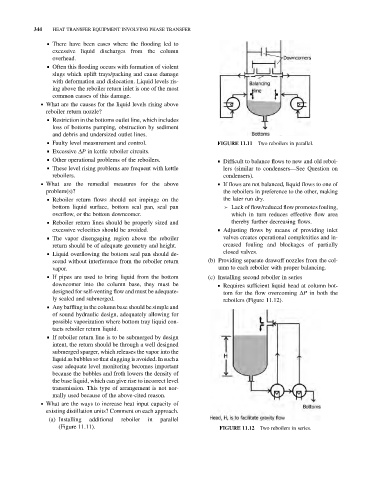
                 & Faulty level measurement and control.                              Two reboilers in parallel.
                                                                         FIGURE 11.11
                 & Excessive DP in kettle reboiler circuits.
                 & Other operational problems of the reboilers.          & Difficult to balance flows to new and old reboi-
                 & These level rising problems are frequent with kettle    lers (similar to condensers—See Question on
                  reboilers.                                               condensers).
               . What are the remedial measures for the above            & If flows are not balanced, liquid flows to one of
                problem(s)?                                                the reboilers in preference to the other, making
                 & Reboiler return flows should not impinge on the          the later run dry.
                  bottom liquid surface, bottom seal pan, seal pan         ➢ Lack of flow/reduced flow promotes fouling,
                  overflow, or the bottom downcomer.                          which in turn reduces effective flow area
                 & Reboiler return lines should be properly sized and        thereby further decreasing flows.
                  excessive velocities should be avoided.                & Adjusting flows by means of providing inlet
                 & The vapor disengaging region above the reboiler         valves creates operational complexities and in-
                  return should be of adequate geometry and height.        creased fouling and blockages of partially
                 & Liquid overflowing the bottom seal pan should de-        closed valves.
                  scend without interference from the reboiler return  (b) Providing separate drawoff nozzles from the col-
                  vapor.                                                 umn to each reboiler with proper balancing.
                 & If pipes are used to bring liquid from the bottom  (c) Installing second reboiler in series
                  downcomer into the column base, they must be           & Requires sufficient liquid head at column bot-
                  designed for self-venting flow and must be adequate-      tom for the flow overcoming DP in both the
                  ly sealed and submerged.                                 reboilers (Figure 11.12).
                 & Any baffling in the column base should be simple and
                  of sound hydraulic design, adequately allowing for
                  possible vaporization where bottom tray liquid con-
                  tacts reboiler return liquid.
                 & If reboiler return line is to be submerged by design
                  intent, the return should be through a well designed
                  submerged sparger, which releases the vapor into the
                  liquid as bubblesso that slugging is avoided. In such a
                  case adequate level monitoring becomes important
                  because the bubbles and froth lowers the density of
                  the base liquid, which can give rise to incorrect level
                  transmission. This type of arrangement is not nor-
                  mally used because of the above-cited reason.
               . What are the ways to increase heat input capacity of
                existing distillation units? Comment on each approach.
                 (a) Installing  additional  reboiler  in  parallel
                    (Figure 11.11).                                       FIGURE 11.12 Two reboilers in series.

