


Page 359 - Fluid mechanics, heat transfer, and mass transfer
P. 359
REBOILERS    341

                    60% of the shell diameter. Other criteria include  & True.
                    keeping a minimum height of 0.3 m or 1.3 to 1.6  . “In horizontal thermosiphon reboilers, fluid is not taken
                    times the bundle diameter (whichever is greater)  on the tube side.” Comment.
                    above the liquid level.
                                                                     & Due to their inability to establish a vertical density
                & Normally the vapor outlet is in the center above the  gradient inside horizontally aligned tubes.
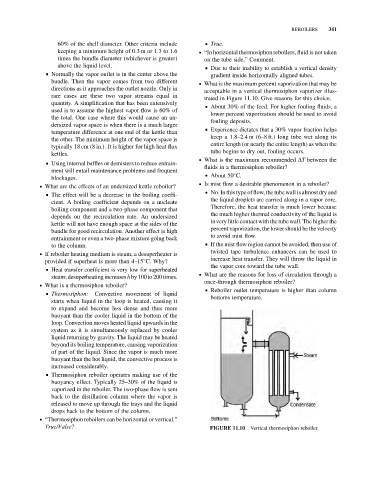
                  bundle. Then the vapor comes from two different  . What is the maximum percent vaporization that may be
                  directions as it approaches the outlet nozzle. Only in
                                                                    acceptable in a vertical thermosiphon vaporizer illus-
                  rare cases are these two vapor streams equal in
                                                                    trated in Figure 11.10. Give reasons for this choice.
                  quantity. A simplification that has been extensively
                                                                     & About 30% of the feed. For higher fouling fluids, a
                  used is to assume the highest vapor flow is 60% of
                                                                       lower percent vaporization should be used to avoid
                  the total. One case where this would cause an un-
                                                                       fouling deposits.
                  dersized vapor space is when there is a much larger
                                                                     & Experience dictates that a 30% vapor fraction helps
                  temperature difference at one end of the kettle than
                                                                       keep a 1.8–2.4 m (6–8 ft.) long tube wet along its
                  the other. The minimum height of the vapor space is
                                                                       entire length (or nearly the entire length) as when the
                  typically 18 cm (8 in.). It is higher for high heat flux
                                                                       tube begins to dry out, fouling occurs.
                  kettles.
                                                                   . What is the maximum recommended DT between the
                & Using internal baffles or demisters to reduce entrain-
                                                                    fluids in a thermosiphon reboiler?
                  ment will entail maintenance problems and frequent
                                                                     & About 50 C.

                  blockages.
                                                                   . Is mist flow a desirable phenomenon in a reboiler?
              . What are the effects of an undersized kettle reboiler?
                                                                     & No. In this type offlow, the tubewall is almost dry and
                & The effect will be a decrease in the boiling coeffi-
                                                                       the liquid droplets are carried along in a vapor core.
                  cient. A boiling coefficient depends on a nucleate
                                                                       Therefore, the heat transfer is much lower because
                  boiling component and a two-phase component that
                                                                       the much higher thermal conductivity of the liquid is
                  depends on the recirculation rate. An undersized
                                                                       invery little contact with the tubewall. The higher the
                  kettle will not have enough space at the sides of the
                                                                       percent vaporization, the lower should be thevelocity
                  bundle for good recirculation. Another effect is high
                                                                       to avoid mist flow.
                  entrainment or even a two-phase mixture going back
                  to the column.                                     & If the mist flow region cannot be avoided, then use of
                                                                       twisted tape turbulence enhancers can be used to
              . If reboiler heating medium is steam, a desuperheater is
                                                                       increase heat transfer. They will throw the liquid in
                provided if superheat is more than 4–15 C. Why?

                                                                       the vapor core toward the tube wall.
                & Heat transfer coefficient is very low for superheated
                                                                   . What are the reasons for loss of circulation through a
                  steam;desuperheatingincreaseshby100to200times.
                                                                    once-through thermosiphon reboiler?
              . What is a thermosiphon reboiler?
                                                                     & Reboiler outlet temperature is higher than column
                & Thermosiphon:  Convective movement of liquid
                                                                       bottoms temperature.
                  starts when liquid in the loop is heated, causing it
                  to expand and become less dense and thus more
                  buoyant than the cooler liquid in the bottom of the
                  loop. Convection moves heated liquid upwards in the
                  system as it is simultaneously replaced by cooler
                  liquid returning by gravity. The liquid may be heated
                  beyond its boiling temperature, causing vaporization
                  of part of the liquid. Since the vapor is much more
                  buoyant than the hot liquid, the convective process is
                  increased considerably.
                & Thermosiphon reboiler operates making use of the
                  buoyancy effect. Typically 25–30% of the liquid is
                  vaporized in the reboiler. The two-phase flow is sent
                  back to the distillation column where the vapor is
                  released to move up through the trays and the liquid
                  drops back to the bottom of the column.
              . “Thermosiphon reboilers can be horizontal or vertical.”
                True/False?                                           FIGURE 11.10 Vertical thermosiphon reboiler.

