


Page 354 - Fluid mechanics, heat transfer, and mass transfer
P. 354
HEAT TRANSFER EQUIPMENT INVOLVING PHASE TRANSFER
            336
                  vacuum and exchanger failure becomes a possibility.  & For those installations where cooling water sources
                  This problem gets aggravated, especially for large   produce rapid fouling of the tubes, a higher factor
                  diameter shells when condensing fluid is on the shell  must be used.
                  side.                                            . What are the effects of weather on condenser duties?
               . What is the generally recommended temperature ap-   & Can limit production in summer.
                proach in steam condensers in air conditioning and   & Capable of condensing more vapor at night than
                power plants?
                                                                       during day. This situation will be more pronounced
                 & Lowest feasible approach (steam condensing tem-
                                                                       in plants located in desert atmospheres.
                  perature minus entering cooling water temperature)  . “When light components accumulate, condensation is

                  is 3 C.
                                                                     impeded.” True/False? Explain.
                 & Generally the approach used in most air conditioning
                                                                     & True. Presence of light components and/or noncon-


                  installations is 10 C but not less than 5 C, to save on
                                                                       densables reduce condenser capacity due to reduced
                  costs involved in large heat transfer surface
                                                                       heat transfer coefficients.
                  requirements.
                                                                     & Solution  for  this  problem  is  to  vent
               . What is meant by cleanliness factor?
                                                                       noncondensables.
                 & Cleanliness factor is defined as 100   (U Design /
                                                                   . “Condensation inside tubes is not appropriate for vac-
                  U Clean ).
                                                                     uum column overhead condenser because ....”
               . What is the normally recommended cleanliness factor  Comment.
                for the design of condensers for air conditioning and  & This statement is true because of the high tube side
                power plants?
                                                                       DP and the difficulty in piping and supporting a
                 & Most surface condensers for air conditioning and
                                                                       vertically mounted condenser. Therefore, condensa-
                  power plant applications are designed with a clean-  tion is the best choice.
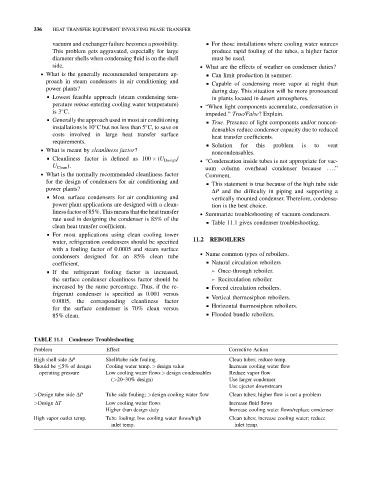
                  liness factor of 85%. This means that the heat transfer  . Summarize troubleshooting of vacuum condensers.
                  rate used in designing the condenser is 85% of the
                                                                     & Table 11.1 gives condenser troubleshooting.
                  clean heat transfer coefficient.
                 & For most applications using clean cooling tower
                  water, refrigeration condensers should be specified  11.2  REBOILERS
                  with a fouling factor of 0.0005 and steam surface
                                                                   . Name common types of reboilers.
                  condensers designed for an 85% clean tube
                  coefficient.                                        & Natural circulation reboilers
                 & If the refrigerant fouling factor is increased,     ➢ Once-through reboiler.
                  the surface condenser cleanliness factor should be   ➢ Recirculation reboiler.
                  increased by the same percentage. Thus, if the re-  & Forced circulation reboilers.
                  frigerant condenser is specified as 0.001 versus
                                                                     & Vertical thermosiphon reboilers.
                  0.0005,  the  corresponding  cleanliness  factor
                                                                     & Horizontal thermosiphon reboilers.
                  for the surface condenser is 70% clean versus
                  85% clean.                                         & Flooded bundle reboilers.

            TABLE 11.1  Condenser Troubleshooting
            Problem                 Effect                                   Corrective Action
            High shell side DP      Shell/tube side fouling                  Clean tubes; reduce temp.
            Should be  5% of design  Cooling water temp. > design value      Increase cooling water flow
              operating pressure    Low cooling water flows > design condensables  Reduce vapor flow
                                      (>20–30% design)                       Use larger condenser
                                                                             Use ejector downstream
            >Design tube side DP    Tube side fouling; >design cooling water flow  Clean tubes; higher flow is not a problem
            >Design DT              Low cooling water flows                   Increase fluid flows
                                    Higher than design duty                  Increase cooling water flows/replace condenser
            High vapor outlet temp.  Tube fouling; low cooling water flows/high  Clean tubes; increase cooling water; reduce
                                      inlet temp.                              inlet temp.

