


Page 352 - Fluid mechanics, heat transfer, and mass transfer
P. 352
HEAT TRANSFER EQUIPMENT INVOLVING PHASE TRANSFER
            334
                                                                       ➢ Physical arrangement of the heating surface to
                                                                         properly move the vapors past the heating surface
                                                                         and the condensables out through the vent.
                                                                     & Noncondensable gases reduce heat transfer rates in
                                                                       two ways:
                                                                       ➢ Heat transfer coefficient is reduced because heat
                                                                         must be transferred across a gas film if noncon-
                                                                         densables are present in significant concentration,
                                                                         the available temperature difference is reduced
                                                                         because the condensation is no longer isothermal.
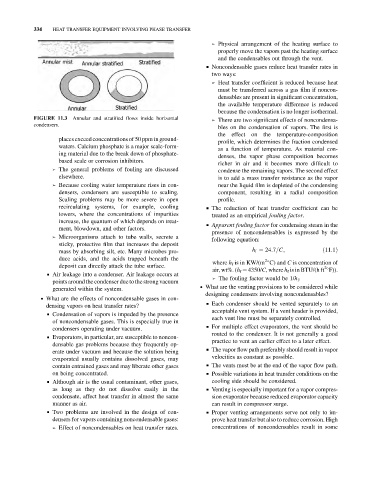
                         Annular and stratified flows inside horizontal
            FIGURE 11.3                                                ➢ There are two significant effects of noncondensa-
            condensers.
                                                                         bles on the condensation of vapors. The first is
                                                                         the effect  on the  temperature-composition
                    places exceed concentrations of 50 ppm in ground-
                                                                         profile, which determines the fraction condensed
                    waters. Calcium phosphate is a major scale-form-
                                                                         as a function of temperature. As material con-
                    ing material due to the break down of phosphate-
                                                                         denses, the vapor phase composition becomes
                    based scale or corrosion inhibitors.
                                                                         richer in air and it becomes more difficult to
                  ➢ The general problems of fouling are discussed        condense the remaining vapors. The second effect
                    elsewhere.                                           is to add a mass transfer resistance as the vapor
                  ➢ Because cooling water temperature rises in con-      near the liquid film is depleted of the condensing
                    densers, condensers are susceptible to scaling.      component, resulting in a radial composition
                    Scaling problems may be more severe in open          profile.
                    recirculating systems, for example, cooling      & The reduction of heat transfer coefficient can be
                    towers, where the concentrations of impurities     treated as an empirical fouling factor.
                    increase, the quantum of which depends on treat-
                                                                     & Apparent fouling factor for condensing steam in the
                    ment, blowdown, and other factors.
                                                                       presence of noncondensables is expressed by the
                  ➢ Microorganisms attach to tube walls, secrete a
                                                                       following equation:
                    sticky, protective film that increases the deposit
                    mass by absorbing silt, etc. Many microbes pro-                 h f ¼ 24:7=C;           ð11:1Þ
                    duce acids, and the acids trapped beneath the
                                                                       where h f is in KW/(m C) and C is concentration of
                                                                                        2
                    deposit can directly attack the tube surface.
                                                                                                            2
                                                                       air, wt%. (h f ¼ 4350/C, where h f is in BTU/(h ft F)).
                 & Air leakage into a condenser. Air leakage occurs at
                                                                       ➢ The fouling factor would be 1/h f .
                  points around the condenser due to the strongvacuum
                                                                   . What are the venting provisions to be considered while
                  generated within the system.
                                                                     designing condensers involving noncondensables?
               . What are the effects of noncondensable gases in con-
                                                                     & Each condenser should be vented separately to an
                densing vapors on heat transfer rates?
                                                                       acceptable vent system. If a vent header is provided,
                 & Condensation of vapors is impeded by the presence
                                                                       each vent line must be separately controlled.
                  of noncondensable gases. This is especially true in
                                                                     & For multiple effect evaporators, the vent should be
                  condensers operating under vacuum.
                                                                       routed to the condenser. It is not generally a good
                 & Evaporators, in particular, are susceptible to noncon-
                                                                       practice to vent an earlier effect to a later effect.
                  densable gas problems because they frequently op-
                                                                     & The vapor flow path preferably should result in vapor
                  erate under vacuum and because the solution being
                                                                       velocities as constant as possible.
                  evaporated usually contains dissolved gases, may
                  contain entrained gases and may liberate other gases  & The vents must be at the end of the vapor flow path.
                  on being concentrated.                             & Possible variations in heat transfer conditions on the
                 & Although air is the usual contaminant, other gases,  cooling side should be considered.
                  as long as they do not dissolve easily in the      & Venting is especially important for a vapor compres-
                  condensate, affect heat transfer in almost the same  sion evaporator because reduced evaporator capacity
                  manner as air.                                       can result in compressor surge.
                 & Two problems are involved in the design of con-   & Proper venting arrangements serve not only to im-
                  densers for vapors containing noncondensable gases:  prove heat transfer but also to reduce corrosion. High
                  ➢ Effect of noncondensables on heat transfer rates.  concentrations of noncondensables result in some

