


Page 355 - Fluid mechanics, heat transfer, and mass transfer
P. 355
REBOILERS    337

                & Recirculating, baffled bottom reboilers.          . What are the important configuration selection factors
                & Fired heaters carrying out reboiler duties.       for reboilers?
              . What are the factors that must be considered in the  & Forced versus natural circulation.
                selection of reboilers?                              & Tube side versus shell side vaporization.
                & Total duty required.                               & Once-through versus process recirculation.
                & Fraction of distillation column liquid vaporized.  & Single versus multiple shell systems.
                & Cleanability (Fouling): Tube side is easier to clean  & Vertical versus horizontal orientation.
                  than shell side.                                   & Column internal bundles.
                & Corrosion: Corrosion may dictate use of expensive  & Other types.
                  alloys and to save costs, corrosive fluid must be  . Illustrate, by means of diagrams, different configura-
                  placed inside tubes, avoiding an expensive shell, in
                                                                    tions for the operation of reboilers and discuss their
                  addition to alloy tubes.
                                                                    characteristics.
                & Pressure: High-pressure fluids are placed inside
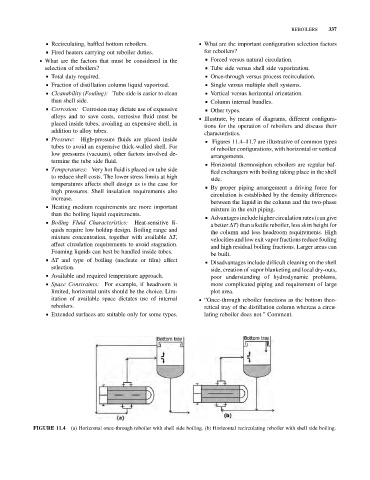
                                                                     & Figures 11.4–11.7 are illustrative of common types
                  tubes to avoid an expensive thick-walled shell. For
                                                                       of reboiler configurations, with horizontal or vertical
                  low pressures (vacuum), other factors involved de-
                                                                       arrangements.
                  termine the tube side fluid.
                                                                     & Horizontal thermosiphon reboilers are regular baf-
                & Temperatures: Very hot fluid is placed on tube side
                                                                       fled exchangers with boiling taking place in the shell
                  to reduce shell costs. The lower stress limits at high
                                                                       side.
                  temperatures affects shell design as is the case for
                                                                     & By proper piping arrangement a driving force for
                  high pressures. Shell insulation requirements also
                                                                       circulation is established by the density differences
                  increase.
                                                                       between the liquid in the column and the two-phase
                & Heating medium requirements are more important
                                                                       mixture in the exit piping.
                  than the boiling liquid requirements.
                                                                     & Advantages include higher circulation rates (can give
                & Boiling Fluid Characteristics:  Heat-sensitive li-
                                                                       a better DT) than a kettle reboiler, less skirt height for
                  quids require low holdup design. Boiling range and
                                                                       the column and less headroom requirements. High
                  mixture concentration, together with available DT,
                                                                       velocities and low exit vapor fractions reduce fouling
                  affect circulation requirements to avoid stagnation.
                                                                       and high residual boiling fractions. Larger areas can
                  Foaming liquids can best be handled inside tubes.
                                                                       be built.
                & DT and type of boiling (nucleate or film) affect
                                                                     & Disadvantages include difficult cleaning on the shell
                  selection.
                                                                       side, creation of vapor blanketing and local dry-outs,
                & Available and required temperature approach.
                                                                       poor understanding of hydrodynamic problems,
                & Space Constraints: For example, if headroom is       more complicated piping and requirement of large
                  limited, horizontal units should be the choice. Lim-  plot area.
                  itation of available space dictates use of internal  . “Once-through reboiler functions as the bottom theo-
                  reboilers.                                        retical tray of the distillation column whereas a circu-
                & Extended surfaces are suitable only for some types.  lating reboiler does not.” Comment.


                        (a) Horizontal once-through reboiler with shell side boiling. (b) Horizontal recirculating reboiler with shell side boiling.
            FIGURE 11.4

