


Page 350 - Fluid mechanics, heat transfer, and mass transfer
P. 350
HEAT TRANSFER EQUIPMENT INVOLVING PHASE TRANSFER
            332
                 & Ions.                                             & Condenser capacity is reduced.
                 & Solids produced by combustion in upstream         & Heat transfer coefficient for condensation is 20 to 30
                  processing.                                          times more than for cooling of liquids.
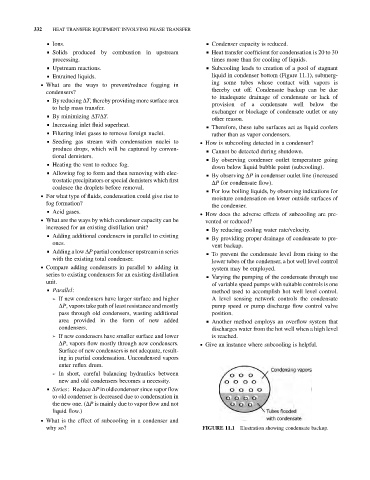
                 & Upstream reactions.                               & Subcooling leads to creation of a pool of stagnant
                 & Entrained liquids.                                  liquid in condenser bottom (Figure 11.1), submerg-
                                                                       ing some tubes whose contact with vapors is
               . What are the ways to prevent/reduce fogging in
                                                                       thereby cut off. Condensate backup can be due
                condensers?
                                                                       to inadequate drainage of condensate or lack of
                 & By reducing DT, thereby providing more surface area
                                                                       provision of a condensate well  below  the
                  to help mass transfer.
                                                                       exchanger or blockage of condensate outlet or any
                 & By minimizing DT/DY.
                                                                       other reason.
                 & Increasing inlet fluid superheat.
                                                                     & Therefore, these tube surfaces act as liquid coolers
                 & Filtering inlet gases to remove foreign nuclei.
                                                                       rather than as vapor condensers.
                 & Seeding gas stream with condensation nuclei to  . How is subcooling detected in a condenser?
                  produce drops, which will be captured by conven-   & Cannot be detected during shutdown.
                  tional demisters.
                                                                     & By observing condenser outlet temperature going
                 & Heating the vent to reduce fog.
                                                                       down below liquid bubble point (subcooling).
                 & Allowing fog to form and then removing with elec-
                                                                     & By observing DP in condenser outlet line (increased
                  trostatic precipitators or special demisters which first
                                                                       DP for condensate flow).
                  coalesce the droplets before removal.
                                                                     & For low boiling liquids, by observing indications for
               . For what type of fluids, condensation could give rise to
                                                                       moisture condensation on lower outside surfaces of
                fog formation?
                                                                       the condenser.
                 & Acid gases.
                                                                   . How does the adverse effects of subcooling are pre-
               . What are the ways by which condenser capacity can be  vented or reduced?
                increased for an existing distillation unit?
                                                                     & By reducing cooling water rate/velocity.
                 & Adding additional condensers in parallel to existing
                                                                     & By providing proper drainage of condensate to pre-
                  ones.
                                                                       vent backup.
                 & Adding a low DP partial condenser upstream in series
                                                                     & To prevent the condensate level from rising to the
                  with the existing total condenser.
                                                                       lower tubes of the condenser, a hot well level control
               . Compare adding condensers in parallel to adding in    system may be employed.
                series to existing condensers for an existing distillation  & Varying the pumping of the condensate through use
                unit.
                                                                       of variable speed pumps with suitable controls is one
                 & Parallel:
                                                                       method used to accomplish hot well level control.
                  ➢ If new condensers have larger surface and higher   A level sensing network controls the condensate
                    DP, vapors take path of least resistance and mostly  pump speed or pump discharge flow control valve
                    pass through old condensers, wasting additional    position.
                    area provided in the form of new added           & Another method employs an overflow system that
                    condensers.                                        discharges water from the hot well when a high level
                  ➢ If new condensers have smaller surface and lower   is reached.
                    DP, vapors flow mostly through new condensers.  . Give an instance where subcooling is helpful.
                    Surface of new condensers is not adequate, result-
                    ing in partial condensation. Uncondensed vapors
                    enter reflux drum.
                  ➢ In short, careful balancing hydraulics between
                    new and old condensers becomes a necessity.
                 & Series : Reduce DP in old condenser sincevapor flow
                  to old condenser is decreased due to condensation in
                  the new one. (DP is mainly due to vapor flow and not
                  liquid flow.)
               . What is the effect of subcooling in a condenser and
                why so?                                             FIGURE 11.1  Illustration showing condensate backup.

