


Page 95 - Foundations Of Differential Calculus
P. 95
78    5. On the Differentiation of Algebraic Functions of One Variable
                n−2
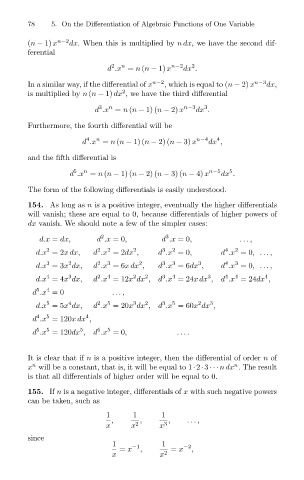
        (n − 1) x  dx. When this is multiplied by ndx, we have the second dif-
        ferential
                              2
                                                   2
                                n
                             d .x = n (n − 1) x n−2 dx .
        In a similar way, if the differential of x n−2 , which is equal to (n − 2) x n−3 dx,
                                 2
        is multiplied by n (n − 1) dx , we have the third differential
                           3  n                  n−3  3
                          d .x = n (n − 1) (n − 2) x  dx .
        Furthermore, the fourth differential will be
                       4  n                         n−4  4
                      d .x = n (n − 1) (n − 2) (n − 3) x  dx ,
        and the fifth differential is
                    5
                                                            5
                       n
                   d .x = n (n − 1) (n − 2) (n − 3) (n − 4) x n−5 dx .
        The form of the following differentials is easily understood.
        154. As long as n is a positive integer, eventually the higher differentials
        will vanish; these are equal to 0, because differentials of higher powers of
        dx vanish. We should note a few of the simpler cases:
                           2                3
           d.x = dx,      d .x =0,         d .x =0,            ...,
             2            2  2      2      3  2            4  2
          d.x =2x dx,    d .x =2dx ,      d .x =0,        d .x =0, ...,
             3     2      2  3       2     3  3     3      4  3
          d.x =3x dx,    d .x =6xdx ,     d .x =6dx ,     d .x =0, ...,
                          2
                                              4
                                                       3
                             4
                                                                      4
                                                           4
                                                              4
                   3
             4
                                    2
                                           3
                                       2
          d.x =4x dx,    d .x =12x dx ,d .x =24xdx ,d .x =24dx ,
          5  4
         d .x =0              ...,
             5     4      2  5      3  2   3  5     2  3
          d.x =5x dx,    d .x =20x dx ,d .x =60x dx ,
          4  5         4
         d .x = 120xdx ,
          5  5        5   6  5
         d .x = 120dx ,d .x =0,                ....
        It is clear that if n is a positive integer, then the differential of order n of
                                                              n
         n
        x will be a constant, that is, it will be equal to 1·2·3 ··· ndx . The result
        is that all differentials of higher order will be equal to 0.
        155. If n is a negative integer, differentials of x with such negative powers
        can be taken, such as
                             1     1       1
                              ,      ,       ,    ...,
                            x      x 2    x 3
        since
                              1    −1      1     −2
                                = x  ,       = x   ,
                              x           x 2

