


Page 229 - Foundations of Cognitive Psychology : Core Readings
P. 229
234   Albert S. Bregman

                occluded our view of the underneath shape). These spaces should be ignored
                and treated as missing evidence, not as actual spaces. The continuity among the
                contours of the fragments of a particular B undoubtedly contributes to their
                grouping, but this continuity becomes effective only in the presence of occlu-
                sion information.
                  The conclusion to be reached is this: the closure mechanism is really a way of
                dealing with missing evidence. But before our perceptual systems are willing
                to employ it, they first have to be shown that some evidence is missing. This
                explains how we can see figures with actual gaps in them; we have no reason to
                believe that the missing parts are merely being hidden. Figures 9.13 and 9.14
                indicate that Gestalt principles are just oblique glimpses of a process of scene
                analysis that looks as much like an evidence-processing system as like the sim-
                ple grouping-by-attraction system described by Gestalt psychology.
                  There is evidence that principles of grouping act in an equally subtle way in
                audition. There is a problem in hearing that is much like the problem of occlu-
                sion in seeing. This is the phenomenon of masking. Masking occurs when a
                loud sound covers up or drowns out a softer one. Despite the masking, if the
                softer sound is longer, and can be heard both before and after a brief burst of
                the louder one, it can be heard to continue behind the louder one just as B’s
                were seen as continuing behind the occluding blob in figure 9.14, and as the
                circle seemed to continue behind the occluding form in the example of figure
                9.5. What is more, even if the softer sound is physically removed during the brief
                loud sound, it is still heard as continuing through the interruption.
                  This illusion has many names, but I will refer to it as the illusion of continu-
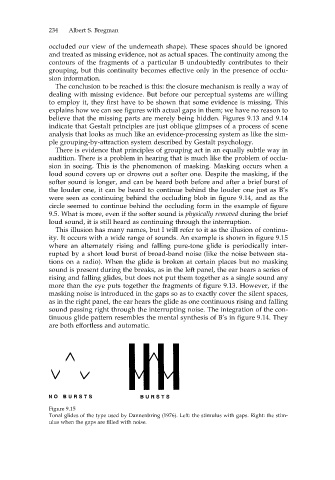
                ity. It occurs with a wide range of sounds. An example is shown in figure 9.15
                where an alternately rising and falling pure-tone glide is periodically inter-
                rupted by a short loud burst of broad-band noise (like the noise between sta-
                tions on a radio). When the glide is broken at certain places but no masking
                sound is present during the breaks, as in the left panel, the ear hears a series of
                rising and falling glides, but does not put them together as a single sound any
                more than the eye puts together the fragments of figure 9.13. However, if the
                masking noise is introduced in the gaps so as to exactly cover the silent spaces,
                as in the right panel, the ear hears the glide as one continuous rising and falling
                sound passing right through the interrupting noise. The integration of the con-
                tinuous glide pattern resembles the mental synthesis of B’s in figure 9.14. They
                are both effortless and automatic.


                Figure 9.15
                Tonal glides of the type used by Dannenbring (1976). Left: the stimulus with gaps. Right: the stim-
                ulus when the gaps are filled with noise.

