


Page 230 - Foundations of Cognitive Psychology : Core Readings
P. 230
The Auditory Scene  235

                 Again you could see the auditory effect as an example of the Gestalt principle
               of closure. However another way of looking at it may be more profitable.
               Richard Warren has interpreted it as resulting from an auditory mechanism
               that compensates for masking. 10  He has shown that the illusion can be obtained
               only when the interrupting noise would have masked the signal if it had really
               been there. The interrupting noise must be loud enough and have the right
               frequency components to do so. Putting that in the context of this chapter, we
               see that the illusion is another oblique glance of the auditory scene-analysis
               process in action.
                 We have seen how two types of explanation, one deriving from Gestalt psy-
               chology and the other derived from considerations of scene analysis, have been
               applicable to both the streaming and continuity effects. They differ in style. The
               Gestalt explanation sees the principles of grouping as phenomena in them-
               selves, a self-sufficient system whose business it is to organize things. The
               scene-analysis approach relates the process more to the environment, or, more
               particularly, to the problem that the environment poses to the perceiver as he
               or she (or it) tries to build descriptions of environmental situations.


               Sequential versus Spectral Organization

               Perceptual Decomposition of Complex Sounds
               We have looked at two laboratory phenomena in audition that show the activ-
               ity of the scene-analysis process: the streaming effect and the illusory continu-
               ation of one sound behind another. There is a third phenomenon that deserves
               to be mentioned in this introductory chapter. It is introduced here not to dem-
               onstrate a parallel between vision and audition, but to show another dimension
               of the grouping problem. This is the perceptual decomposition of simultaneous
               sounds. It can be illustrated through an experiment by Bregman and Pinker. 11
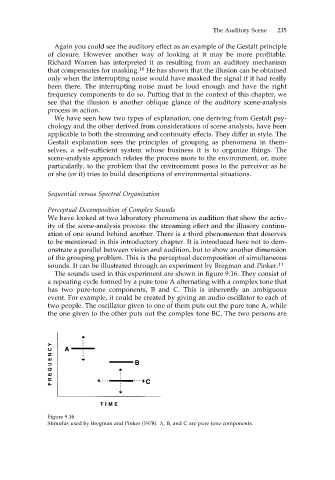
                 The sounds used in this experiment are shown in figure 9.16. They consist of
               arepeating cycleformedbyapuretoneAalternatingwithacomplextonethat
               has two pure-tone components, B and C. This is inherently an ambiguous
               event. For example, it could be created by giving an audio oscillator to each of
               two people. The oscillator given to one of them puts out the pure tone A, while
               the one given to the other puts out the complex tone BC. The two persons are


               Figure 9.16
               Stimulus used by Bregman and Pinker (1978). A, B, and C are pure tone components.

