


Page 128 - From Bombay to Bollywoord The Making of a Global Media Industri
P. 128
Dot-Coms and the Making of an Overseas Territory  >>  115


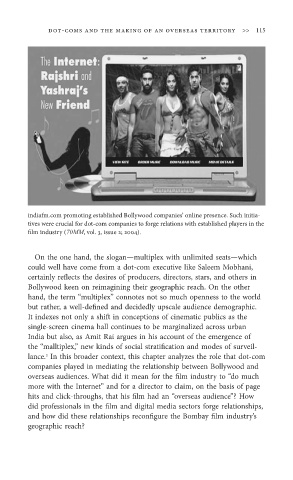
        indiafm.com promoting established Bollywood companies’ online presence. Such initia-
        tives were crucial for dot-com companies to forge relations with established players in the
        film industry (70MM, vol. 3, issue 2; 2004).


          On the one hand, the slogan—multiplex with unlimited seats—which
        could well have come from a dot-com executive like Saleem Mobhani,
        certainly reflects the desires of producers, directors, stars, and others in
        Bollywood keen on reimagining their geographic reach. On the other
        hand, the term “multiplex” connotes not so much openness to the world
        but rather, a well-defined and decidedly upscale audience demographic.
        It indexes not only a shift in conceptions of cinematic publics as the
        single-screen cinema hall continues to be marginalized across urban
        India but also, as Amit Rai argues in his account of the emergence of
        the “malltiplex,” new kinds of social stratification and modes of surveil-
        lance.  In this broader context, this chapter analyzes the role that dot-com
             2
        companies played in mediating the relationship between Bollywood and
        overseas audiences. What did it mean for the film industry to “do much
        more with the Internet” and for a director to claim, on the basis of page
        hits and click-throughs, that his film had an “overseas audience”? How
        did professionals in the film and digital media sectors forge relationships,
        and how did these relationships reconfigure the Bombay film industry’s
        geographic reach?

