


Page 130 - From Bombay to Bollywoord The Making of a Global Media Industri
P. 130
Dot-Coms and the Making of an Overseas Territory  >>  117


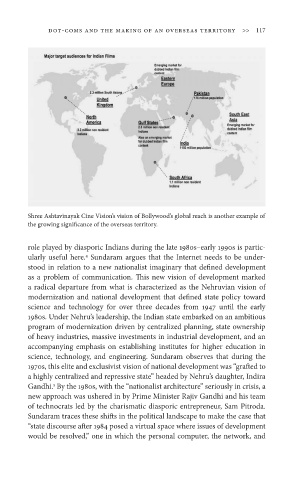
        Shree Ashtavinayak Cine Vision’s vision of Bollywood’s global reach is another example of
        the growing significance of the overseas territory.


        role played by diasporic Indians during the late 1980s–early 1990s is partic-
                       4
        ularly useful here.  Sundaram argues that the Internet needs to be under-
        stood in relation to a new nationalist imaginary that defined development
        as a problem of communication. This new vision of development marked
        a radical departure from what is characterized as the Nehruvian vision of
        modernization and national development that defined state policy toward
        science and technology for over three decades from 1947 until the early
        1980s. Under Nehru’s leadership, the Indian state embarked on an ambitious
        program of modernization driven by centralized planning, state ownership
        of heavy industries, massive investments in industrial development, and an
        accompanying emphasis on establishing institutes for higher education in
        science, technology, and engineering. Sundaram observes that during the
        1970s, this elite and exclusivist vision of national development was “grafted to
        a highly centralized and repressive state” headed by Nehru’s daughter, Indira
               5
        Gandhi.  By the 1980s, with the “nationalist architecture” seriously in crisis, a
        new approach was ushered in by Prime Minister Rajiv Gandhi and his team
        of technocrats led by the charismatic diasporic entrepreneur, Sam Pitroda.
        Sundaram traces these shifts in the political landscape to make the case that
        “state discourse after 1984 posed a virtual space where issues of development
        would be resolved,” one in which the personal computer, the network, and

