


Page 439 - Fundamentals of Enhanced Oil and Gas Recovery
P. 439
Microbial Enhanced Oil Recovery: Microbiology and Fundamentals                      427


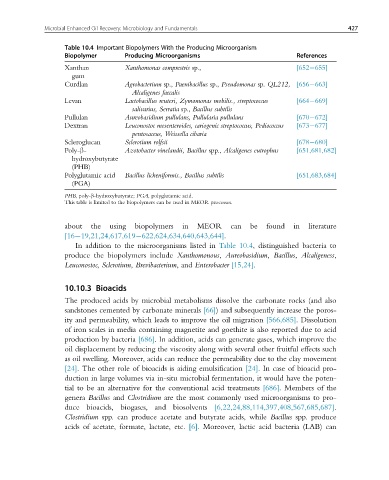
                   Table 10.4 Important Biopolymers With the Producing Microorganism
                   Biopolymer       Producing Microorganisms                       References
                   Xanthan          Xanthomonas comprestris sp.,                   [652 655]
                     gum
                   Curdlan          Agrobacterium sp., Paenibacillus sp., Pseudomonas sp. QL212, [656 663]
                                      Alcaligenes faecalis
                   Levan            Lactobacillus reuteri, Zymomonas mobilis., streptococcus  [664 669]
                                      salivarius, Serratia sp., Bacillus subtilis
                   Pullulan         Aureobasidium pullulans, Pullularia pullulans  [670 672]
                   Dextran          Leuconostoc mesenteroides, cariogenic streptococcus, Pediococcus  [673 677]
                                      pentosaceus, Weissella cibaria
                   Scleroglucan     Sclerotium rolfsii                             [678 680]
                   Poly-β-          Azotobacter vinelandii, Bacillus spp., Alcaligenes eutrophus  [651,681,682]
                     hydroxybutyrate
                     (PHB)
                   Polyglutamic acid  Bacillus licheniformis., Bacillus subtilis   [651,683,684]
                     (PGA)

                   PHB, poly-β-hydroxybutyrate; PGA, polyglutamic acid.
                   This table is limited to the biopolymers can be used in MEOR processes.


                   about  the  using  biopolymers   in  MEOR     can  be   found  in   literature
                   [16 19,21,24,617,619 622,624,634,640,643,644].
                      In addition to the microorganisms listed in Table 10.4, distinguished bacteria to
                   produce the biopolymers include Xanthomonous, Aureobasidium, Bacillus, Alcaligeness,
                   Leuconostoc, Sclerotium, Brevibacterium, and Enterobacter [15,24].


                   10.10.3 Bioacids

                   The produced acids by microbial metabolisms dissolve the carbonate rocks (and also
                   sandstones cemented by carbonate minerals [66]) and subsequently increase the poros-
                   ity and permeability, which leads to improve the oil migration [566,685]. Dissolution
                   of iron scales in media containing magnetite and goethite is also reported due to acid
                   production by bacteria [686]. In addition, acids can generate gases, which improve the
                   oil displacement by reducing the viscosity along with several other fruitful effects such
                   as oil swelling. Moreover, acids can reduce the permeability due to the clay movement
                   [24]. The other role of bioacids is aiding emulsification [24]. In case of bioacid pro-
                   duction in large volumes via in-situ microbial fermentation, it would have the poten-
                   tial to be an alternative for the conventional acid treatments [686]. Members of the
                   genera Bacillus and Clostridium are the most commonly used microorganisms to pro-
                   duce bioacids, biogases, and biosolvents [6,22,24,88,114,397,408,567,685,687].
                   Clostridium spp. can produce acetate and butyrate acids, while Bacillus spp. produce
                   acids of acetate, formate, lactate, etc. [6]. Moreover, lactic acid bacteria (LAB) can

