


Page 434 - Fundamentals of Enhanced Oil and Gas Recovery
P. 434
422                                                                            Afshin Tatar


                Table 10.2 (Continued)
                Surfactant type         Producing Microorganisms            References
                Biodispersan            Acinetobacter calcoaceticus         [464,514,515]
                Liposan                 Candida lipolytica                  [516 518]
                Carbohydrate lipid protein Pseudomonas fluorescens, Yarrowia lipolytica,  [441,519,520]
                                          Pseudomonas nautica
                Mannan lipid protein    Candida tropicalis                  [521 524]
                Particulate surfactant
                Vesicles                Acinetobacter calcoaceticus         [441,468,525]
                Cells                   Various bacteria                    [441,510]
                Source: Data are gathered from different sources [441,464,468,470 525].


                3. Fatty acids, neutral lipids and phospholipids;
                4. Polymeric surfactants; and
                5. Particulate surfactant.
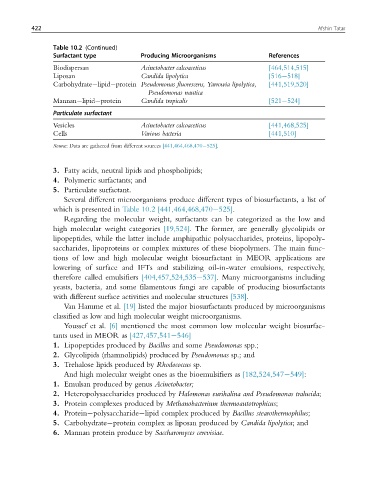
                   Several different microorganisms produce different types of biosurfactants, a list of
                which is presented in Table 10.2 [441,464,468,470 525].
                   Regarding the molecular weight, surfactants can be categorized as the low and
                high molecular weight categories [19,524]. The former, are generally glycolipids or
                lipopeptides, while the latter include amphipathic polysaccharides, proteins, lipopoly-
                saccharides, lipoproteins or complex mixtures of these biopolymers. The main func-
                tions of low and high molecular weight biosurfactant in MEOR applications are
                lowering of surface and IFTs and stabilizing oil-in-water emulsions, respectively,
                therefore called emulsifiers [404,457,524,535 537]. Many microorganisms including
                yeasts, bacteria, and some filamentous fungi are capable of producing biosurfactants
                with different surface activities and molecular structures [538].
                   Van Hamme et al. [19] listed the major biosurfactants produced by microorganisms
                classified as low and high molecular weight microorganisms.
                   Youssef et al. [6] mentioned the most common low molecular weight biosurfac-
                tants used in MEOR as [427,457,541 546]
                1. Lipopeptides produced by Bacillus and some Pseudomonas spp.;
                2. Glycolipids (rhamnolipids) produced by Pseudomonas sp.; and
                3. Trehalose lipids produced by Rhodococcus sp.
                   And high molecular weight ones as the bioemulsifiers as [182,524,547 549]:
                1. Emulsan produced by genus Acinetobacter;
                2. Heteropolysaccharides produced by Halomonas eurihalina and Pseudomonas tralucida;
                3. Protein complexes produced by Methanobacterium thermoautotrophicus;
                4. Protein polysaccharide lipid complex produced by Bacillus stearothermophilus;
                5. Carbohydrate protein complex as liposan produced by Candida lipolytica; and
                6. Mannan protein produce by Saccharomyces cerevisiae.

