


Page 431 - Fundamentals of Enhanced Oil and Gas Recovery
P. 431
Microbial Enhanced Oil Recovery: Microbiology and Fundamentals                      419


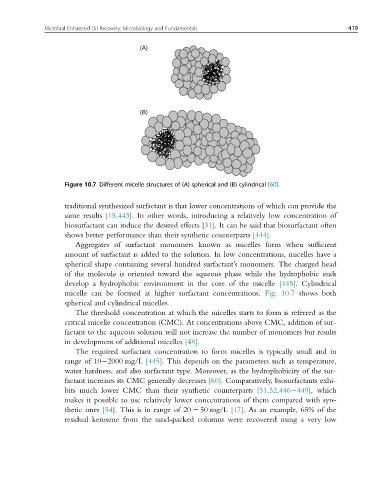
                   Figure 10.7 Different micelle structures of (A) spherical and (B) cylindrical [60].

                   traditional synthesized surfactant is that lower concentrations of which can provide the
                   same results [15,443]. In other words, introducing a relatively low concentration of
                   biosurfactant can induce the desired effects [31]. It can be said that biosurfactant often
                   shows better performance than their synthetic counterparts [444].
                      Aggregates of surfactant monomers known as micelles form when sufficient
                   amount of surfactant is added to the solution. In low concentrations, micelles have a
                   spherical shape containing several hundred surfactant’s monomers. The charged head
                   of the molecule is oriented toward the aqueous phase while the hydrophobic ends
                   develop a hydrophobic environment in the core of the micelle [445]. Cylindrical
                   micelle can be formed at higher surfactant concentrations. Fig. 10.7 shows both
                   spherical and cylindrical micelles.
                      The threshold concentration at which the micelles starts to form is referred as the
                   critical micelle concentration (CMC). At concentrations above CMC, addition of sur-
                   factant to the aqueous solution will not increase the number of monomers but results
                   in development of additional micelles [48].
                      The required surfactant concentration to form micelles is typically small and in
                   range of 10 2000 mg/L [445]. This depends on the parameters such as temperature,
                   water hardness, and also surfactant type. Moreover, as the hydrophobicity of the sur-
                   factant increases its CMC generally decreases [60]. Comparatively, biosurfactants exhi-
                   bits much lower CMC than their synthetic counterparts [51,52,446 449], which
                   makes it possible to use relatively lower concentrations of them compared with syn-
                   thetic ones [54]. This is in range of 20 2 50 mg/L [17]. As an example, 65% of the
                   residual kerosene from the sand-packed columns were recovered using a very low

