


Page 426 - Fundamentals of Enhanced Oil and Gas Recovery
P. 426
414                                                                            Afshin Tatar


                                                           (Single 5-spot pattern shown)
                        Microorganisms
                         and nutrients
                              Injection      Production well
                               pump
                                                      Produced oil
                                                      and products
                      Injection
                       well


                                                 Microbial
                              Driving      Microor-  products  Oil and  Preflush
                               fluid  Nutrients  ganisms  for  products  to condition
                              (water)            releasing     reservoir
                                                   oil

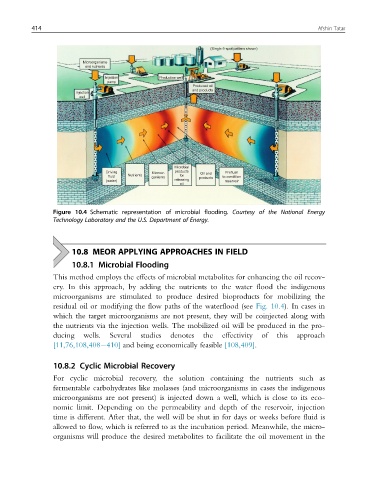
                Figure 10.4 Schematic representation of microbial flooding. Courtesy of the National Energy
                Technology Laboratory and the U.S. Department of Energy.


                     10.8 MEOR APPLYING APPROACHES IN FIELD
                     10.8.1 Microbial Flooding

                This method employs the effects of microbial metabolites for enhancing the oil recov-
                ery. In this approach, by adding the nutrients to the water flood the indigenous
                microorganisms are stimulated to produce desired bioproducts for mobilizing the
                residual oil or modifying the flow paths of the waterflood (see Fig. 10.4). In cases in
                which the target microorganisms are not present, they will be coinjected along with
                the nutrients via the injection wells. The mobilized oil will be produced in the pro-
                ducing  wells.  Several  studies  denotes  the  effectivity  of  this  approach
                [11,76,108,408 410] and being economically feasible [108,409].


                10.8.2 Cyclic Microbial Recovery
                For cyclic microbial recovery, the solution containing the nutrients such as
                fermentable carbohydrates like molasses (and microorganisms in cases the indigenous
                microorganisms are not present) is injected down a well, which is close to its eco-
                nomic limit. Depending on the permeability and depth of the reservoir, injection
                time is different. After that, the well will be shut in for days or weeks before fluid is
                allowed to flow, which is referred to as the incubation period. Meanwhile, the micro-
                organisms will produce the desired metabolites to facilitate the oil movement in the

