


Page 427 - Fundamentals of Enhanced Oil and Gas Recovery
P. 427
Microbial Enhanced Oil Recovery: Microbiology and Fundamentals                      415


                   porous media and consequently increase the oil recovery. At the end of the incubation
                   period, the well is backed to production and oil along with the produced biochem-
                   icals will be produced. The injection rate and also the kinetics of the microbial process
                   will determine the area to be affected by bacteria [407]. This process might be
                   repeated several times to maximize the oil recovery, hence, this process has been
                   referred as microbial huff and puff too [411].
                      McInenery et al. [412] categorized the cyclic oil recovery in two main categories of
                   (1) well stimulation and (2) fermentative microbially enhanced waterflooding processes.
                   The difference is that in the latter, the injected nutrients (and microorganisms in cases
                   the indigenous microorganisms are not present) are injected deep into the reservoir
                   rather than to the well vicinity. Well stimulation approach was used in several early field
                   trials due its simplicity [78,413,414]. Hitzman [78] specified this approach has been the

                   most effective in carbonate well with a temperature range of 35 40 C, oil gravity of
                                3
                   875 965 kg/m , and salinities less than 100 g/L. It should be noted there have been
                   inconsistencies in results acquired from several field trials and also little changes in the
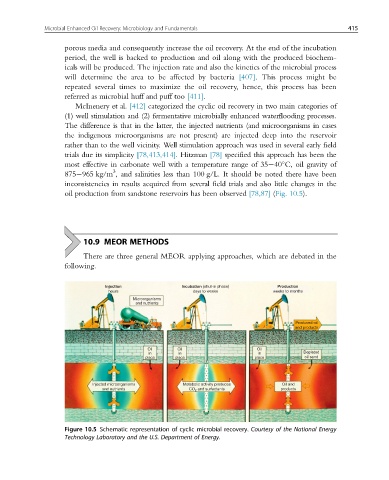
                   oil production from sandstone reservoirs has been observed [78,87] (Fig. 10.5).


                        10.9 MEOR METHODS

                        There are three general MEOR applying approaches, which are debated in the
                   following.

                              Injection            Incubation (shut-in phase)  Production
                               hours                   days to weeks         weeks to months
                                      Microorganisms
                                       and nutrients

                                                                                   Produced oil
                                                                                   and products

                                          Oil     Oil                   Oil
                                          in      in                     in          Depleted
                                         place    place                 place        oil sand


                           Injected microorganisms  Metabolic activity produces  Oil and
                             and nutrients           CO 2  and surfactants     products


                   Figure 10.5 Schematic representation of cyclic microbial recovery. Courtesy of the National Energy
                   Technology Laboratory and the U.S. Department of Energy.

