


Page 478 - Fundamentals of Enhanced Oil and Gas Recovery
P. 478
466                                                                            Afshin Tatar


                           O     Breaking of the          O                      O
                                  ester bond
                   R 1  C                         R 1  C                 R 1  C
                                                            –
                           O                              O                      OH
                              R 2
                     Glass
                                              Possible enzyme effect


                   Water


                                        Oil          More electrostatic repulsion due to
                                                         breaking of ester bonds


                                                           Shift to water-wet
                                                              behavior

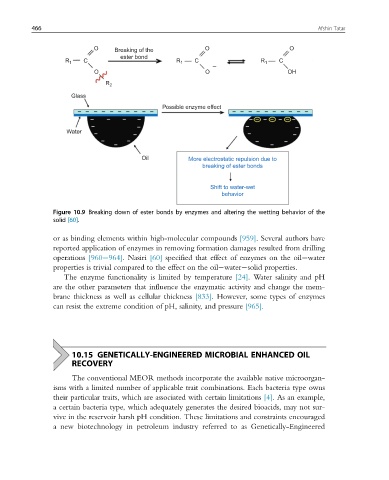
                Figure 10.9 Breaking down of ester bonds by enzymes and altering the wetting behavior of the
                solid [60].

                or as binding elements within high-molecular compounds [959]. Several authors have
                reported application of enzymes in removing formation damages resulted from drilling
                operations [960 964]. Nasiri [60] specified that effect of enzymes on the oil water
                properties is trivial compared to the effect on the oil water solid properties.
                   The enzyme functionality is limited by temperature [24]. Water salinity and pH
                are the other parameters that influence the enzymatic activity and change the mem-
                brane thickness as well as cellular thickness [833]. However, some types of enzymes
                can resist the extreme condition of pH, salinity, and pressure [965].


                     10.15 GENETICALLY-ENGINEERED MICROBIAL ENHANCED OIL
                     RECOVERY

                     The conventional MEOR methods incorporate the available native microorgan-
                isms with a limited number of applicable trait combinations. Each bacteria type owns
                their particular traits, which are associated with certain limitations [4]. As an example,
                a certain bacteria type, which adequately generates the desired bioacids, may not sur-
                vive in the reservoir harsh pH condition. These limitations and constraints encouraged
                a new biotechnology in petroleum industry referred to as Genetically-Engineered

