


Page 318 - Fundamentals of Ocean Renewable Energy Generating Electricity From The Sea
P. 318
Other Aspects of Ocean Renewable Energy Chapter | 10 301


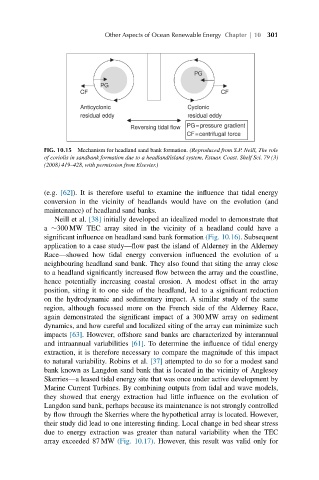
             FIG. 10.15  Mechanism for headland sand bank formation. (Reproduced from S.P. Neill, The role
             of coriolis in sandbank formation due to a headland/island system, Estuar. Coast. Shelf Sci. 79 (3)
             (2008) 419–428, with permission from Elsevier.)


             (e.g. [62]). It is therefore useful to examine the influence that tidal energy
             conversion in the vicinity of headlands would have on the evolution (and
             maintenance) of headland sand banks.
                Neill et al. [38] initially developed an idealized model to demonstrate that
             a ∼300 MW TEC array sited in the vicinity of a headland could have a
             significant influence on headland sand bank formation (Fig. 10.16). Subsequent
             application to a case study—flow past the island of Alderney in the Alderney
             Race—showed how tidal energy conversion influenced the evolution of a
             neighbouring headland sand bank. They also found that siting the array close
             to a headland significantly increased flow between the array and the coastline,
             hence potentially increasing coastal erosion. A modest offset in the array
             position, siting it to one side of the headland, led to a significant reduction
             on the hydrodynamic and sedimentary impact. A similar study of the same
             region, although focussed more on the French side of the Alderney Race,
             again demonstrated the significant impact of a 300 MW array on sediment
             dynamics, and how careful and localized siting of the array can minimize such
             impacts [63]. However, offshore sand banks are characterized by interannual
             and intraannual variabilities [61]. To determine the influence of tidal energy
             extraction, it is therefore necessary to compare the magnitude of this impact
             to natural variability. Robins et al. [37] attempted to do so for a modest sand
             bank known as Langdon sand bank that is located in the vicinity of Anglesey
             Skerries—a leased tidal energy site that was once under active development by
             Marine Current Turbines. By combining outputs from tidal and wave models,
             they showed that energy extraction had little influence on the evolution of
             Langdon sand bank, perhaps because its maintenance is not strongly controlled
             by flow through the Skerries where the hypothetical array is located. However,
             their study did lead to one interesting finding. Local change in bed shear stress
             due to energy extraction was greater than natural variability when the TEC
             array exceeded 87 MW (Fig. 10.17). However, this result was valid only for

