


Page 307 - Gas Purification 5E
P. 307
Removal and Use of Ammonia in Gas Purification   291


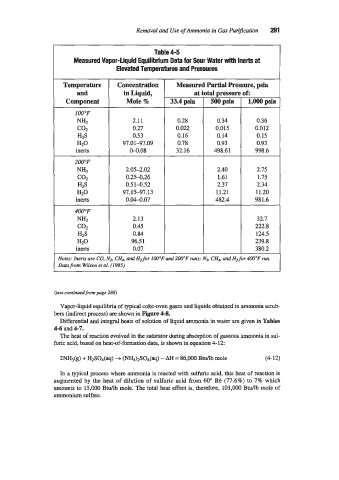
                                               Table 4-5
                       Measured Vapor-liquid Equilibrium Data for Sour Water with lnerts at
                                    Elevated Temperatures and Pressures

                    Temperature     Concentration  I   Measured Partial Pressure, psia
                        and           inLiquid,   1           ital pressure of:
                     Component         Mole %       33.4 psia   500psia  I  1,000psia
                                                           at

                                        2.11          0.28       0.34        0.36
                                        0.27         0.022       0.015       0.012
                                        0.53          0.16        0.14       0.15
                                      97.01-97.09     0.78       0.93        0.93
                                        04.08        32.16       498.61      998.6


                                      2.05-2.02                   2.40       2.75
                                      0.25-0.26                   1.61        1.75
                                      0.51-0.52                   2.37       2.34
                                      97.15-97.13                11.21       11.20
                                      0.04-0.07                  482.4       981.6
                                                                        I

                                                                             32.7
                                                                             222.8

                                        96.5 1                               239.8
                                                                             380.2
                  Notes: Inerts are CO, N2, CH,  and Ht for I00"F and 200°F runs; Nz, CHd. and H2 for 400°F run.
                  Data from Wilson et aL (1985)


                 (text continued from page 286)
                   Vapor-liquid equilibria of typical coke-oven gases and liquids obtained in ammonia scrub-
                 bers (indirect process) are shown in Figure 4-8.
                   Differential and integral heats of solution of liquid ammonia in water are given in Tables
                 4-6 and 47.
                   The heat of reaction evolved in the saturator during absorption of gaseous ammonia in sul-
                 furic acid, based on heat-of-formation data, is shown in equation 4-12:

                   2NH3(g) + HzS04(aq) + (NHJ2S04(aq) - AH = 86,000 BWlb mole   (4- 12)
                   In a typical process where ammonia is reacted with sulfuric acid, this heat of reaction is
                 augmented by the heat of  dilution of  sulfuric acid from 60" BB  (77.6%) to 7% which
                 amounts to 15,000 BtuAb mole. The total heat effect is, therefore, 101,000 Btdb mole of
                 ammonium sulfate.

