


Page 142 - gas transport in porous media
P. 142
Chapter 8: Gas Injection and Fingering in Porous Media
                                                                                           135
                           miscible displacement much less efficient than desired. In addition, in most misci-
                           ble displacement processes involving a gas the required temperature and pressure
                           for miscibility of the oil and the displacement agent are often high enough that they
                           limit the number of prospective reservoirs. For example, medium to heavy hydrocar-
                           bons become miscible with oil only at high temperatures and/or pressures (see, e.g.,
                           Sahimi et al., 1985; Sahimi and Taylor, 1991). Another negative aspect of a miscible
                           displacement process is its cost. It may happen that a miscible displacement is more
                           efficient in terms of the amount of the recovered oil than an immiscible injection,
                           but the total cost of the miscible displacement (including the cost of transporting the
                           displacing gas to the oil field from other locations) is so high that makes it econom-
                           ically unattractive. Moreover, flue gas and nitrogen have only limited application as
                           agents of a miscible displacement in deep and high pressure reservoirs. For these
                           reasons, EOR processes based on gas injection have not been as common as immisci-
                           ble displacement processes, such as water flooding, although they are used relatively
                           extensively.


                           8.2  FACTORS THAT AFFECT THE EFFICIENCY OF
                           MISCIBLE DISPLACEMENTS

                           Miscible gas injection as an EOR process is influenced by several factors. Although
                           these factors are well-known, there is still some disagreement on the extent of the
                           influence of each individual factor. For example, while laboratory experiments indi-
                           cate that the viscosity contrast between the oil and the displacing gas has a strong
                           effect on the efficiency of the miscible displacements, the same may not be true at
                           the field scale which is dominated by large-scale heterogeneities, such as the spatial
                           distributions of the permeability and porosity and the presence of fractures and/or
                           faults. In what follows, we describe the effect of some of the most important factors
                           on the efficiency of a miscible displacement by a gas (or any other fluid, for that
                           matter).

                           8.2.1  Mobility and Mobility Ratio

                           The mobility λ i of a fluid i is defined as the ratio of the effective permeability K i
                           of the porous medium, experienced by fluid i, and the fluid’s viscosity µ i , λ i =
                           K i /µ i . When one fluid displaces another, the mobility ratio M, defined as the ratio
                           of the mobilities of the displacing and displaced fluids, is one of the most important
                           influencing factors in any displacement process. Normally, M is not constant because
                           mixing of the displacing gas and the oil changes the effective viscosities of the two
                           fluids. In addition, the viscosity of the mixed zone also depends on concentrations
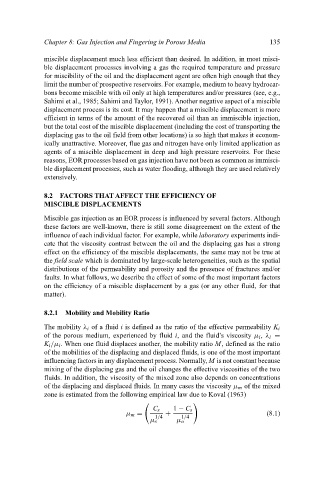
                           of the displacing and displaced fluids. In many cases the viscosity µ m of the mixed
                           zone is estimated from the following empirical law due to Koval (1963)

                                                          C s   1 − C s
                                                  µ m =       +                           (8.1)
                                                           1/4    1/4
                                                         µ s     µ o

