


Page 277 - gas transport in porous media
P. 277
Tidwell
                           274
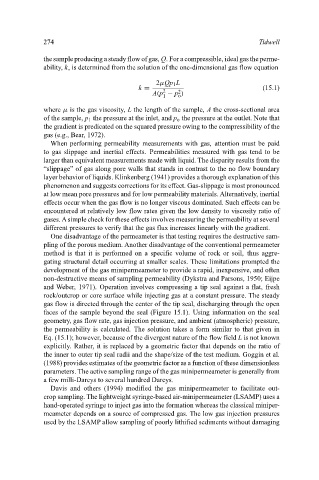
                           the sample producing a steady flow of gas, Q. For a compressible, ideal gas the perme-
                           ability, k, is determined from the solution of the one-dimensional gas flow equation
                                                           2µQp 1 L
                                                      k =    2                           (15.1)
                                                                 2
                                                          A(p − p )
                                                             1   o
                           where µ is the gas viscosity, L the length of the sample, A the cross-sectional area
                           of the sample, p 1 the pressure at the inlet, and p o the pressure at the outlet. Note that
                           the gradient is predicated on the squared pressure owing to the compressibility of the
                           gas (e.g., Bear, 1972).
                             When performing permeability measurements with gas, attention must be paid
                           to gas slippage and inertial effects. Permeabilities measured with gas tend to be
                           larger than equivalent measurements made with liquid. The disparity results from the
                           “slippage” of gas along pore walls that stands in contrast to the no flow boundary
                           layer behavior of liquids. Klinkenberg (1941) provides a thorough explanation of this
                           phenomenon and suggests corrections for its effect. Gas-slippage is most pronounced
                           at low mean pore pressures and for low permeability materials. Alternatively, inertial
                           effects occur when the gas flow is no longer viscous dominated. Such effects can be
                           encountered at relatively low flow rates given the low density to viscosity ratio of
                           gases. Asimple check for these effects involves measuring the permeability at several
                           different pressures to verify that the gas flux increases linearly with the gradient.
                             One disadvantage of the permeameter is that testing requires the destructive sam-
                           pling of the porous medium. Another disadvantage of the conventional permeameter
                           method is that it is performed on a specific volume of rock or soil, thus aggre-
                           gating structural detail occurring at smaller scales. These limitations prompted the
                           development of the gas minipermeameter to provide a rapid, inexpensive, and often
                           non-destructive means of sampling permeability (Dykstra and Parsons, 1950; Eijpe
                           and Weber, 1971). Operation involves compressing a tip seal against a flat, fresh
                           rock/outcrop or core surface while injecting gas at a constant pressure. The steady
                           gas flow is directed through the center of the tip seal, discharging through the open
                           faces of the sample beyond the seal (Figure 15.1). Using information on the seal
                           geometry, gas flow rate, gas injection pressure, and ambient (atmospheric) pressure,
                           the permeability is calculated. The solution takes a form similar to that given in
                           Eq. (15.1); however, because of the divergent nature of the flow field L is not known
                           explicitly. Rather, it is replaced by a geometric factor that depends on the ratio of
                           the inner to outer tip seal radii and the shape/size of the test medium. Goggin et al.
                           (1988) provides estimates of the geometric factor as a function of these dimensionless
                           parameters. The active sampling range of the gas minipermeameter is generally from
                           a few milli-Darcys to several hundred Darcys.
                             Davis and others (1994) modified the gas minipermeameter to facilitate out-
                           crop sampling. The lightweight syringe-based air-minipermeameter (LSAMP) uses a
                           hand-operated syringe to inject gas into the formation whereas the classical miniper-
                           meameter depends on a source of compressed gas. The low gas injection pressures
                           used by the LSAMP allow sampling of poorly lithified sediments without damaging

